
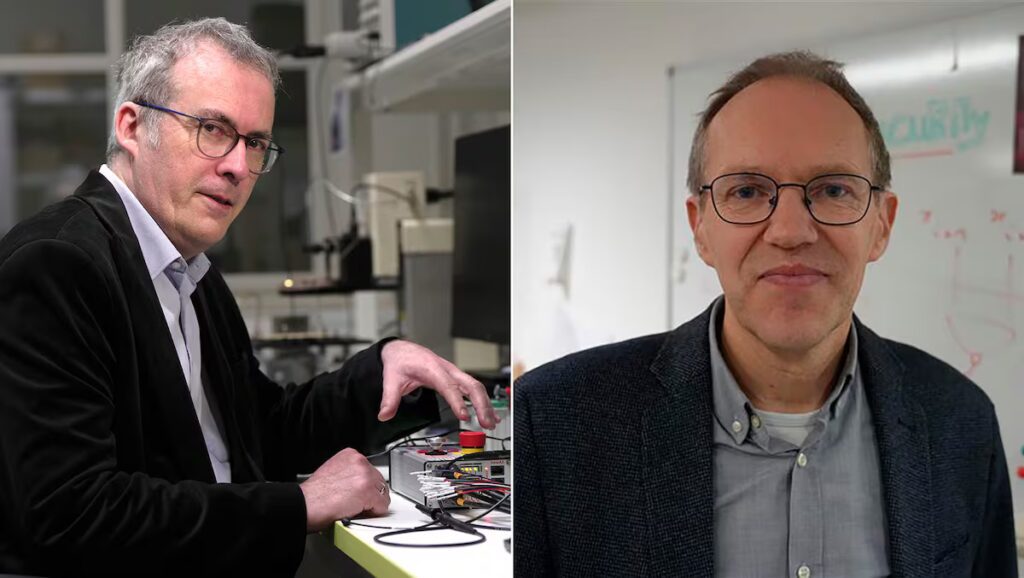
The Advanced Encryption Standard (AES), also known as Rijndael, is a key encryption algorithm that has been instrumental in safeguarding digital security since its inception in the late 1990s. This globally recognized standard protects various digital platforms including laptops, mobile phones, digital messaging systems, payment cards, and cloud data storage. Recently, its creators, Belgian engineers Joan Daemen and Vincent Rijmen, received the prestigious BBVA Foundation Frontiers of Knowledge award in the Information and Communication Technologies (ICT) category.
In its 18th edition, the award's jury praised AES for being the technological backbone of the modern digital age, ensuring the safety of our finances, medical records, and private communications. They noted, “our money remains in our bank accounts, our medical records remain private, and our messages only reach the intended recipients.”
The Rijndael algorithm was developed by Daemen and Rijmen in 1997 as a response to the vulnerabilities of the earlier Data Encryption Standard (DES), which had been widely used by the National Institute of Standards and Technology (NIST) in the United States. As DES began to show significant flaws, NIST initiated a competition to find a stronger encryption method. With their research focused on the mathematical foundations of cryptography, Daemen and Rijmen triumphed in this competition.
One noteworthy aspect of AES is its open-source nature, which has facilitated its widespread adoption and transparency within the cryptographic community. According to the jury, “It is taught in all computer security courses globally and can be scrutinized for vulnerabilities.”
In a video call, Daemen highlighted that despite its origins in the 1990s, ongoing adaptations have kept the algorithm relevant. “We are engaged in advancing cryptography, but I don't anticipate a replacement for AES, as it is ubiquitous and continues to function effectively,” he stated.
Rijmen elaborated on the extensive applications of AES in everyday life, saying, “It was present in the early mobile applications, and it is involved in document printing as modern printers communicate with ink cartridges.” This underscores the pervasive role AES plays in numerous technologies we use daily.
Daemen also addressed the political implications surrounding cryptography, emphasizing that while AES and similar systems serve as foundational tools, the architecture of higher-level security necessitates critical decisions about data management—whether centralized or decentralized. He cited concerns voiced by many cryptographers regarding practices like client-side scanning, a measure aimed at preventing child exploitation but which could also facilitate mass surveillance, particularly in politically sensitive regions.
In the prior iteration of the BBVA award, the recipients included Anil K. Jain and Michael I. Jordan for their significant advancements in artificial intelligence and facial recognition technologies. Their decades-long efforts have enabled machines to identify patterns and predict outcomes, paving the way for transformative innovations in biometrics and generative artificial intelligence.




![Middle-Aged Men in [Location] Prefer Coffee Machines Over Convertibles for Unique Experiences](https://instantvista.com/wp-content/uploads/2026/09/Middle-Aged-Men-in-Location-Prefer-Coffee-Machines-Over-Convertibles-for-150x150.jpg "Middle-Aged Men in [Location] Prefer Coffee Machines Over Convertibles for Unique Experiences 5 - Instant Vista")