
Four years before ChatGPT‘s launch, three master's students from the Tisch School of the Arts at New York University collaborated to integrate neural networks into video image creation. This effort led to the birth of Runway, a pioneering platform that introduced the first AI-powered video generation tool into commercial use. Runway debuted its product a year and a half before OpenAI's Sora and Google's Veo 2 hit the market.
Table of Contents
ToggleThe Vision Behind Runway
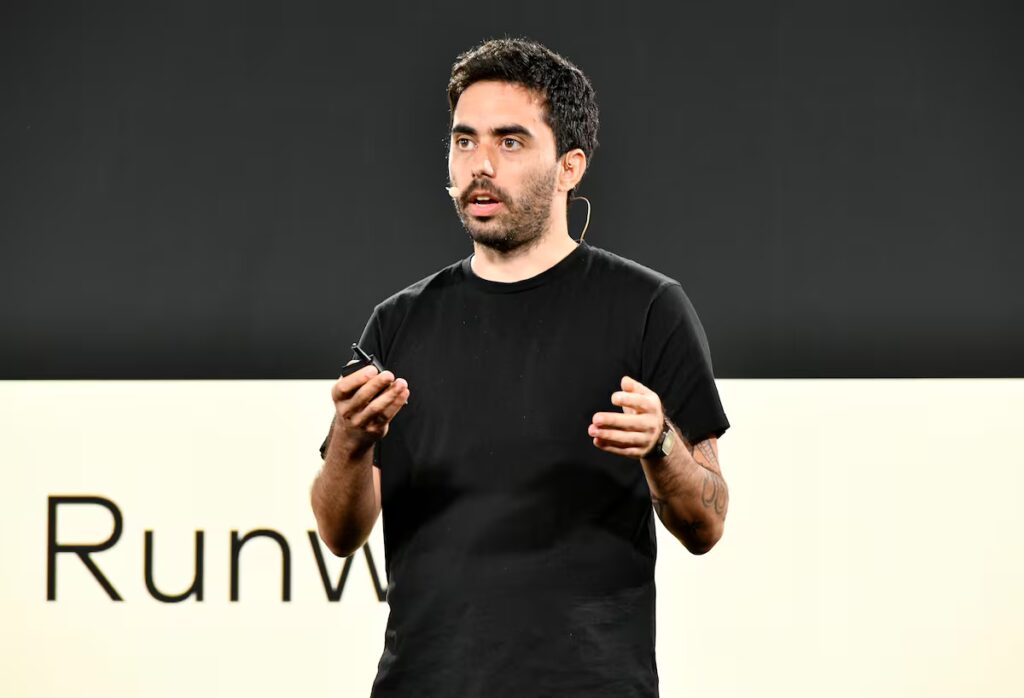
Cristóbal Valenzuela (Santiago de Chile, 1989), co-founder and CEO of Runway, spoke at the Web Summit in Lisbon about the anticipated rapid expansion of AI-generated video. While text generation models raise significant questions, the complexities surrounding video generation models are even more pronounced.
Usage in the Audiovisual Industry
Q. How are your video generation tools currently used in the audiovisual industry?
A. Users leverage Runway for editing, modifying, or generating scenes, especially for large-scale film projects and post-production processes. If you need to add an effect or adjust an element in a scene, you can use Runway to create it and then integrate it into your traditional editing software.
Applications Beyond Cinema
Q. Are there applications outside of film?
A. Initially, our technology was designed with cinema in mind, but it's being adopted in various industries, including advertising, marketing, design, video game development, and even architecture.
Innovations in Architectural Renderings
Q. Can you provide an example?
A. Traditionally, rendering a building involves complex processes using CAD software, including modeling and texturing. For instance, KPF, an architectural firm in the U.S., utilized our tools to create renders, drastically simplifying the workflow. Now, users can input an image and, within ten seconds, receive a generated video, making the process much faster and cost-effective.
Time Efficiency in Film Production
Q. The creators of the series House of David noted significant time savings in scene creation. Can you elaborate?
A. Our technology can cut production times from weeks to days, even from months to days for complex and costly film scenes. Budget reductions accompany this efficiency; creators developed a specialized system to generate images and project them directly onto screens.
The Future of Jobs in the Industry
Q. With many individuals involved in filming, what would you say to those concerned about job security?
A. Technology has always altered employment landscapes. Just as elevator operators became obsolete, some roles will evolve or be automated. However, new job opportunities will emerge, creating demand in areas where AI is applied.
Emerging Roles in AI Video Production
Q. What types of jobs might arise in the realm of generative video?
A. Nowadays, movie production requires professionals skilled in cameras, lenses, and video editing. As AI develops, there will be a need for experts who can adeptly use these new tools, generate videos, and modify content.
Current Limitations of AI-Generated Video
Q. What limitations currently exist in AI-generated video content?
A. Generating cohesive content, such as a 60 to 90-minute film with consistent characters and storylines, remains a challenge, although advancements are anticipated shortly. Additionally, real-time content generation, like personalized video tutorials on demand, is also in development.
AI in Video Games
Q. Can AI-generated video sustain consistency in characters and settings within video games?
A. The gaming sector can be divided into pixel generation and gameplay dynamics. While we are nearing real-time pixel generation, maintaining the underlying game logic remains unresolved but is expected to change soon.
Transforming Video Game Design
Q. How is a video game environment typically designed today?
A. Currently, design teams build all environments over several years. In a first-person shooter like Call of Duty, each element is meticulously placed. Players encounter a static world created by designers.
AI's Role in Game Creation
Q. How will AI change video game environments?
A. In an AI-generated version, elements aren't pre-designed or created beforehand. When players move within the game, the AI will generate unique visuals in real time, offering a new level of unpredictability.
Memory and Persistence in AI Models
Q. Will AI models maintain memory to ensure continuity in gaming scenarios?
A. This is an ongoing focus for us. For instance, if a player drops a bomb in-game, we aim to enable them to revisit that point and witness the consequences as they left them.
Addressing Intellectual Property Concerns
Q. How do you train your tools concerning intellectual property in AI video?
A. We collaborate closely with most Hollywood studios to understand their needs regarding protection. Our approach includes various licensing programs to ensure compliance and security.
The Future of AI in Content Creation
Q. How soon might platforms like Netflix or Amazon Prime allow users to generate and share movies or series using AI, similar to YouTube's model?
A. I believe this is only months away. The technology is already available; the remaining challenge is logistics and distribution. While creating 90-minute films may require more time, user-generated content is already feasible, and I anticipate we will start seeing it in the next year.