
Table of Contents
ToggleAdvancements in Prosthetic Technology: Enhancing Fine Motor Skills
Fine motor skills, developed in early childhood, are crucial for executing precise movements using the small muscles of the hands and fingers. These skills are vital for everyday tasks such as grasping objects, writing, fastening, cutting, and feeding. However, individuals using prosthetic arms and hands face significant challenges, even with the most advanced technologies available. Researchers at the University of Utah are leveraging artificial intelligence (AI) and neural networks to enhance the functionality of prosthetic devices, aiming to restore the fine motor skills essential for daily activities.
Challenges with Bionic Limbs
“Despite advancements in bionic arms, controlling them remains a challenge. Almost half of users abandon their prostheses due to difficulties in control,” states Marshall Trout, a researcher at the NeuroRobotics Laboratory at the University of Utah. This issue stems from the inability of most commercial bionic arms to replicate the sense of touch, which is critical for effective object manipulation.
Innovative Solutions: AI and Neural Networks
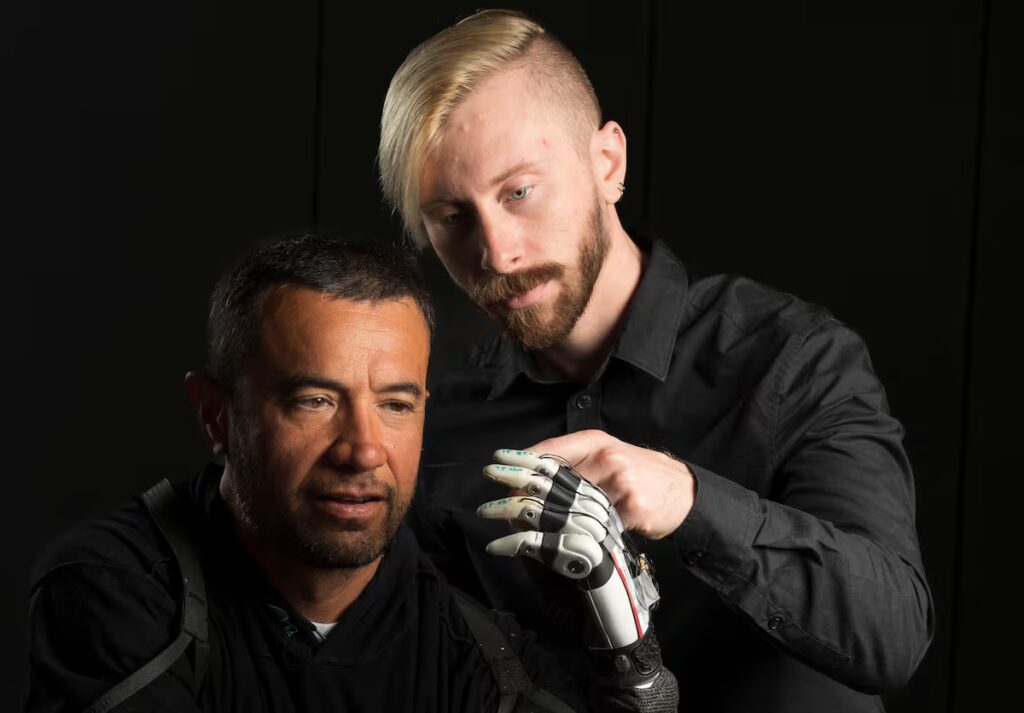
The research addresses these limitations by integrating optical proximity and pressure sensors into a commercial bionic hand. This setup allows for the training of a computer neural network to learn gripping postures, facilitating more natural and autonomous movement compared to traditional devices. The prosthetic hand is equipped with fingertips that detect both the pressure and proximity of objects, enabling users to gauge the volume and mass of various items, such as a cotton ball.
Refining Natural Dexterity
Natural dexterity relies on subconscious brain models that help anticipate interactions between the hand and objects. To tackle this, researchers at the University of Utah trained an artificial neural network model to manipulate fingers with precision for gripping tasks.
Despite these advancements, the system has not fully adapted to user intentions for more complex actions, like holding an object without gripping it tightly or adjusting the speed of the movement. To address this need, the research introduced a novel approach that shares control between the user and the AI system. “Our goal is not for the user to struggle against the machine but for the machine to assist in enhancing the user's natural control,” explains Trout.
Future Aspirations and Applications
Jacob A. George, a professor of Electrical and Computer Engineering at the John and Marcia Price College and lead author of the study, emphasizes the importance of integrating AI into prosthetics. “This work aligns with our broader vision at the Utah NeuroRobotics Laboratory to improve the quality of life for amputees.” The research team is also exploring neural interface technologies that could empower individuals to control prosthetics through thought, as well as restoring tactile sensations.
Research Testing and Outcomes
The system has been tested with nine participants with intact limbs and four amputees in various real-world tasks, including manipulating fragile items like eggs, picking up paper, and drinking from a cup.
Complex Interactions Between Machine and Brain
Tamar Makin, a researcher at the University of Utah and a cognitive neuroscience professor at the University of Cambridge, provides insights on the machine-brain interaction. Makin's research, published in PLOS Biology, reveals that the brain does not represent prostheses as hands or tools but instead generates a unique neural signature to adapt to these devices.
Collaborating with Dani Clode from the Plasticity Laboratory at the University of Cambridge, Makin explores applications of neuroscience in prosthetics, including designs that integrate innovative features, such as an extra auxiliary thumb, to improve functionality.