
Table of Contents
ToggleBeijing Hosts Unique Half Marathon Between Robots and Humans
China showcased its technological prowess this Sunday in Beijing with an extraordinary half marathon where robots competed against human runners. Notably, the competition was unbalanced as the advanced humanoid robots displayed impressive speeds, far exceeding human records.
Shandian – The Star of the Event
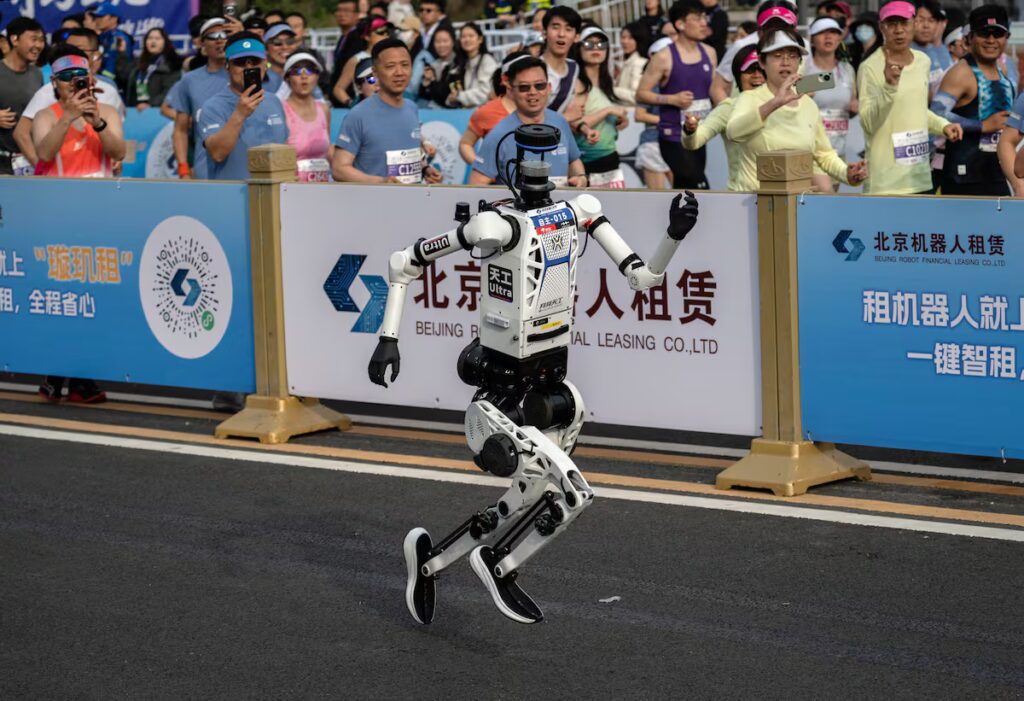
The standout participant, named Shandian—meaning “Lightning” in Mandarin—astonished spectators with its swift performance. As it approached the 11-kilometer marker, onlookers gathered to cheer, marveling at this display of engineering. Shandian's striking red exterior and robust design, featuring agile legs and powerful mechanical joints, allowed it to sprint forward with incredible agility.
Within just 25 minutes of the race start, Shandian zoomed past the curve at kilometer 11 and vanished down the straightaway, leaving onlookers both amused and bewildered. Families, children, and elderly attendees filled the sidelines, capturing the moment on their phones while clutching signs emblazoned with Shandian's name.
Results and Records
Shandian ultimately finished the race in 48 minutes and 19 seconds, obliterating the previous human world record of 57:20 set by Ugandan runner Jakob Kiplimo in March. However, it's important to note that Shandian was controlled remotely and thus saw a penalty compared to fully autonomous robots in the competition. The autonomous version of Shandian finished shortly after, clocking in at 50:26.
This edition of the half marathon marked a significant advancement in robotic capabilities since the last event, where robots struggled to complete the course. The second Beijing half marathon between humans and robots attracted over 12,000 participants, solidifying its status as the world's largest event of its kind.
The Rise of Robotic Technology in China
The event served as a demonstration of China's accelerating technological advancements, reflecting the country's ambition in robotics. In a previous edition, robots were slow and many failed to finish, but this year showcased a remarkable transformation in robotic performance.
China's prominence in the global robotics market is notable, with the nation responsible for about 90% of the 13,000 humanoid robots sold worldwide in the past year. Research suggests that sales of humanoid robots in China are expected to double to 28,000 units in the current year.
Public Sentiment and Future Prospects
Attendees expressed their pride in China's technological achievements, with many recognizing the rapid evolution of robotics. As one spectator remarked, the growth has been astonishing, particularly following the display at the 2025 Spring Festival Gala.
Participants and audience members noted the distinction between human and robotic abilities. While robots operate without physical limitations, humans demonstrate perseverance, emotion, and the capacity for improvement. As the race progressed, spectators became more enthusiastic about the human runners, reacting to their struggles and triumphs, unlike the largely mechanical performances of the robots.
This innovative marathon not only highlighted the advancements in robotics but also raised questions about the role of technology in society and the future of human-robot interaction.