
Table of Contents
ToggleDisinformation Surges After Train Collision in Córdoba
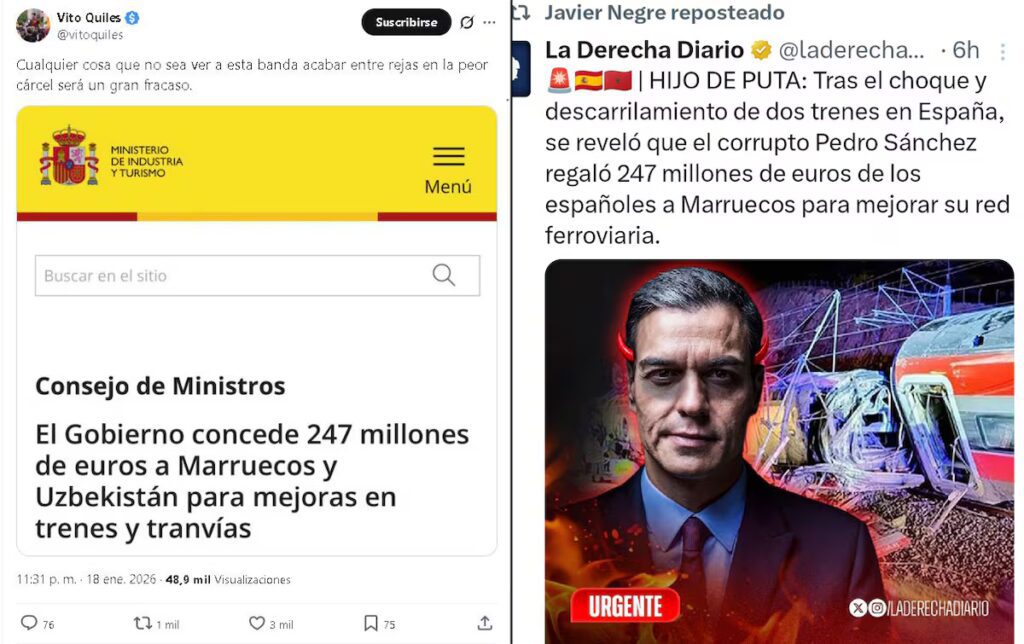
The misinformation campaign erupted just hours after the tragic collision of two high-speed trains near Adamuz, Córdoba, which has resulted in the loss of 39 lives. Prominent figures in the far-right disinformation network, such as Javier Negre, residing in the United States, and Vito Quiles from Spain, quickly began circulating false narratives attributing direct responsibility to Spanish Prime Minister Pedro Sánchez. They claimed that “the corrupt Pedro Sánchez gave 247 million euros from Spain to Morocco to enhance its railway network.”
However, the actual sum involved was 750 million euros, a portion of which was allocated as loans that Morocco will need to repay with interest, specifically intended for contracting Spanish firms. Despite the facts, the urgency to disseminate misleading information during a time of national crisis prevailed over accuracy, tapping into public anxiety for answers.
Alvise Pérez Joins the Misinformation Wave
Shortly thereafter, Member of the European Parliament (MEP) Alvise Pérez, an active participant in online misinformation spheres, echoed these claims on his Telegram channel, which boasts nearly 650,000 subscribers. He accused Sánchez of approving “credits for 1.4 billion euros for railway projects in Morocco, Egypt, and Uzbekistan, while Spain suffers from significant investment shortfalls in its own train infrastructure.”
Investigating the Spread of Hatred
This morning, cybersecurity expert Marcelino Madrigal examined around 400 Telegram messages that targeted Minister of Transport Óscar Puente. He noted that Pérez's channels were among the most prolific in spreading disdainful messages aimed at Puente, framing criticism around a perceived neglect of infrastructure maintenance.
Santiago Abascal, leader of the Vox party, also sought to associate the government with the derailment, declaring, “The collapse of a mafia government is threatening to collapse the entire State both nationally and internationally.” He characterized the current administration as governed by “crime, lies, and betrayal of the people's interests.”
Madrigal observed signs of orchestrated messaging, as numerous posts were dispatched simultaneously, often within seconds of one another—a tactic that is commonplace according to his findings.
Beyond Government Targets
The disinformation campaign not only targeted government officials but included smear tactics against the media. A smiling image of TVE journalist Lourdes Maldonado circulated widely, with misleading narratives asserting a lack of respect for the victims. Despite the image being taken out of context, as it depicted her discussing local acts of solidarity, numerous accounts condemned her and the public broadcaster. Similarly, an image of a smiling Óscar Puente was circulated alongside inflammatory commentary.
Additionally, some media outlets circulated AI-generated fake images of the train crash, further clouding the narrative.
A Recurring Pattern of Misinformation
Incidents of catastrophe often serve as fertile ground for agitators and purveyors of misinformation. This was notably evident in October 2024 after a devastating flood in Valencia, which claimed 229 lives and sparked a wave of falsehoods, including inflated fatality counts and misleading claims about communal responses to institutional inadequacies.
A similar, albeit racially charged, situation unfolded last year in Torre Pacheco, Murcia, where a man's beating was exploited to incite “immigrant hunts.” The individual arrested was of Moroccan descent, but the video circulating as evidence belonged to a separate incident, illustrating how misinformation can provoke real-world consequences and incite community unrest over unfounded fears.