Table of Contents
ToggleEditing Women’s History on Wikipedia
A dedicated group of editors meets every Tuesday, equipped with computers, to address a significant gap in digital knowledge: the underrepresentation and bias in the portrayal of women’s history on Wikipedia. This platform was co-founded 25 years ago by Americans Jimmy Wales and Larry Sanger, marking a time in the internet’s evolution that now feels distant.
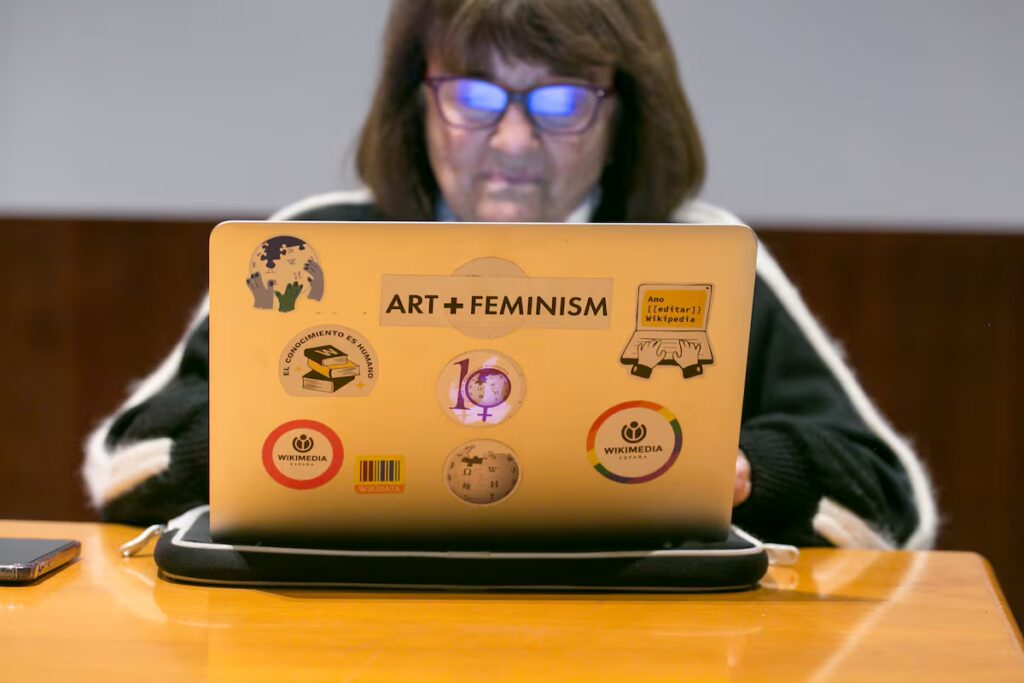
On a March afternoon, eight editors gather in the library of the Reina Sofía Museum in Madrid. Their computer screens display both a Wikipedia editing window and a Zoom call to connect with other participants online. With over a decade of voluntary editing experience, Carmen Galdón, a 61-year-old Social Sciences doctor and the project’s founder, welcomes anyone interested in joining: “Whoever comes is welcome.”
Global Collaborations to Enhance Women’s Representation
This initiative aligns with similar projects globally, such as Wikisphere and Art+Feminism. The editors emphasize the importance of recognizing how autobiographies often diminish women to merely being “the wife of” or “the daughter of.” As Galdón notes, “Language matters; it’s not just about including women, but about how they are included. Failing to sustain focus can reproduce stereotypes.”
Since their inception in October 2015, the collective has enhanced hundreds of Wikipedia entries. Their work includes documenting scientists, forgotten athletes, women persecuted in dictatorial regimes, and influential gallery owners in Spanish art. They also document environmental leaders and pseudonyms of Latin American writers, such as the Association of Women Affected by Forced Sterilizations, which represents victims from the government of Alberto Fujimori in Peru.
A Digital Resource Facing Gender Bias
A study published in PLOS One reported that only 11.6% of active Wikipedia editors were female as of 2021. Another study conducted from 2007 to 2022 found significant gender disparities in contributions, attributed to various barriers that hinder women’s participation, including rejection experiences, time constraints, and limited ownership of knowledge. The challenge of sourcing historical information on women, especially those from earlier centuries, remains a persistent obstacle. “Finding sources about medieval women writers is particularly difficult,” notes 72-year-old Consuelo Fernández, an economist and long-time collaborator of the project.
Much of the documentation available today emerged from conversations organized by the collective. These discussions generate names, topics, references, and questions that evolve into Wikipedia articles. Galdón explains, “We engage in discussions about democratic memory, menopause, end-of-life support, science, and feminism. We listen, gather references, identify potential entries, and then edit accordingly.”
Additional editing occurs in mass edit-a-thons focused on reviving forgotten women’s biographies, while workshops welcome both men and women. Marisa González, an 82-year-old pioneering artist involved in the group, emphasizes their detailed approach: “We uncover sources from unexpected places.” Galdón highlights that all Wikipedia content must be substantiated with reliable sources, including books, studies, and news articles.
The Impact of AI and Reactionary Discourses
As Wikipedia celebrates its 25th anniversary, it does so at a pivotal time for content creation. While maintaining its status as a vital source of information, the rise of artificial intelligence has led to a decrease in direct traffic to the site. Galdón points out, “Despite AI heavily relying on Wikipedia, it often makes the platform invisible.”
The collaborative encyclopedia is sustained through small donations, and Galdón warns, “If people stop participating, donations will cease.” Furthermore, ideological attacks, such as those by Elon Musk, who has critiqued Wikipedia and proposed a conservative AI alternative, pose additional challenges. Galdón asserts, “If there’s an impetus to replace it, it suggests there’s something to be worried about. Wikipedia embodies diverse perspectives.”
Concerns about rising reactionary discourses also inform their work. Despite noting an anti-feminist sentiment among certain youth, Galdón urges against defeatism, remarking on the importance of focusing on progress rather than setbacks. “Discouragement only leads to silence; feminism is inclusive,” she emphasizes, stressing that men also play a crucial role in this endeavor.
As the collective reflects on a decade filled with personal experiences like motherhood, care, illness, and grief, their mission remains clear: to assert their presence on the internet. “That’s why it’s so important to be here,” concludes Galdón.