
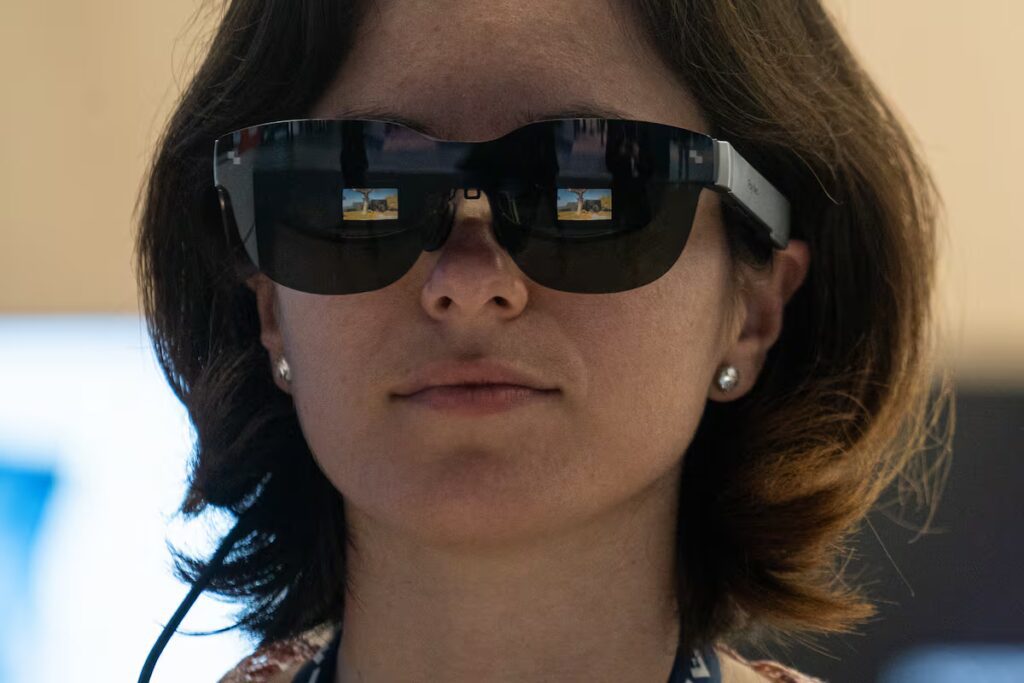
When people think of smart glasses, they often envision an expensive and uncomfortable gadget. A decade ago, Google Glass introduced the idea of transforming glasses into a pocket computer, capable of delivering augmented reality directly in front of users' eyes, without needing a smartphone.
However, the latest generation of smart glasses resembles conventional eyewear more than futuristic devices. Models designed in the style of popular glasses such as the Ray-Ban Wayfarer permite users to handle calls, record first-person videos, listen to music, and follow navigation instructions—all without drawing attention to their special features.
Beyond recreational use, smart glasses technology is being harnessed to enhance professional processes and assist individuals with specific health needs.
Table of Contents
ToggleTransforming Hearing Aids
One of the notable applications of this new generation of smart glasses is in improving hearing capabilities. Unlike traditional hearing aids that fit inside the ear, these glasses adjust through an app, amplifying voices while reducing background noise. Companies like Nuance Audio, backed by EssilorLuxottica, have introduced models classified as class IIa medical devices in the European Union, specifically designed for individuals with mild to moderate hearing loss. Various startups are also investigating similar solutions for those who may not require a clinical hearing aid but still need assistance in social settings or noisy environments.
Applications in Professional and Industrial Settings
In workplaces such as factories, construction sites, and hospitals, these smart glasses act as essential tools that allow workers to access information without diverting their attention from tasks at hand. Here, functionality, durability, and integration with corporate systems take precedence over design.
Following the cancellation of the original Google Glass project, Google has redirected its efforts toward developing smart glasses tailored for professional and industrial use. Companies like Boeing, DHL, and GE utilize this technology, which enhances productivity and minimizes errors through hands-free access to information and first-person visual support. Technicians rely on these devices for audio instructions, process monitoring, and training new employees.
Revolutionizing Learning Experiences
In educational settings, smart glasses are reshaping the way we teach and learn. Particularly in fields requiring hands-on interaction and immediate access to information, these glasses provide contextual details in the user's line of sight. This is especially beneficial in technical or scientific disciplines, enabling students to view step-by-step instructions while conducting experiments or examining diagrams, formulas, and 3D animations related to the equipment they are using.
Microsoft is actively advancing this area with its HoloLens, which enhances the ability for teachers to guide and supervise remote learners interactively compared to traditional methods.
Moreover, experts highlight the accessibility potential of smart glasses: they can amplify sound, translate written text into speech, provide subtitles for conversations aimed at students with hearing challenges, and incorporate visual cues for students with attention deficits.