
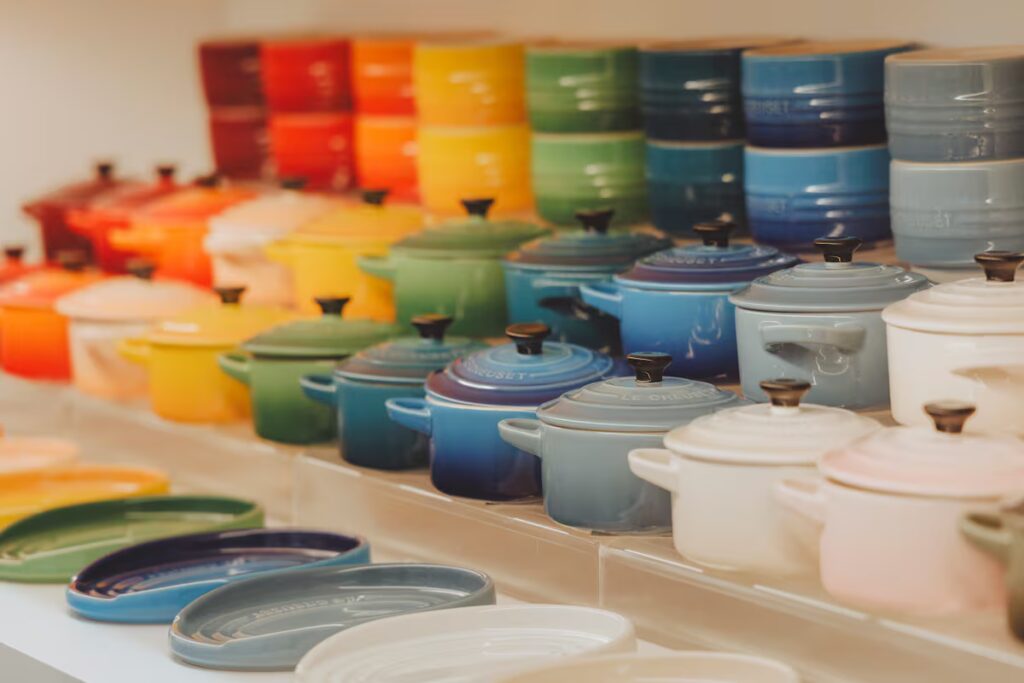
In April 1924, Brussels hosted the International Trade Fair, featuring manufacturers from over 20 countries. It was there that two Belgian industrialists, Armand Desaegher and Octave Aubecq, specialized in cast iron and enameling, respectively, crossed paths. This encounter led to the creation of a cookware icon: Le Creuset, marking the beginning of a kitchenware legacy that would last a century.
The brand was founded a year later in Fresnoy-le-Grand, northern France. The location was strategically chosen due to its railway access, allowing easy procurement of essential raw materials for production.
Table of Contents
ToggleInside Le Creuset’s Factory
Today, the renovated Fresnoy-le-Grand factory continues to produce the renowned enameled cast iron cocottes. These Dutch ovens, famous since the 18th century, are celebrated for their even heat distribution and moisture retention, enhancing the flavors of dishes cooked within. Desaegher and Aubecq enhanced existing designs by enameling the iron, making the pots more resilient and easier to clean. Their iconic “volcanic” orange color pays homage to the molten metal used in production.
As you enter the factory, a small shop showcases vibrant cocottes, contrasting against the factory’s muted tones. Yet, the prominent bursts of orange capture attention: from the molten metal to workers’ uniforms, reflecting the brand’s identity. The factory employs over 800 staff members, producing 10,000 cast iron pieces daily, ensuring each product is meticulously inspected throughout the production stages.
Craftsmanship Meets Technology
The vibrant Le Creuset pots, while associated with premium prices ranging from $175 to over $600, are backed by a “lifetime guarantee,” making them worthwhile investments. Their production involves a blend of artisanal skill and state-of-the-art technology. Enameling, in particular, requires precision; the enamel is formulated to expand alongside the metal during heating, preventing cracks and ensuring durability.
The pots are crafted from blocks of iron, recycled materials, and steel fragments. During production, unique sand molds are created for each piece, which are reprocessed after use. Once cooled, the pots undergo a rigorous inspection, followed by robotic refinements to eliminate imperfections.
Glazing Process
The glazing phase is where challenges arise. The pots are cleaned with fine metal particles for adhesion, and a clear base coat is applied to prevent oxidation. Subsequently, a colored glaze mixture—composed of sand, glass, clay, water, and pigments—is sprayed on, leaving the rim unglazed for proper lid fit. The pots are fired to permanently bond the enamel and metal, followed by another round of quality checks.
The final step before shipping involves attaching knobs and sealing boxes for distribution. All enameled cast iron items are made in Fresnoy-le-Grand, while ceramic products are produced in Lamphun, Thailand. The factory also features a small museum showcasing historical pieces, including designer collaborations from the 1950s to the 1980s.
Le Creuset’s Evolution
Le Creuset has not only survived for a century but has also adapted and expanded its offerings. Acquired in 1988 by South African businessman Paul van Zuydam, the company modernized its production and broadened its product line to include stainless steel, ceramic, non-stick cookware, and various kitchen accessories.
The brand has established itself as an aspirational kitchenware choice, particularly among younger generations attracted to its colorful, photogenic designs and the values of quality and sustainability associated with its products. Le Creuset cocottes not only symbolize adulthood but also serve as collector’s items, enhanced by promotional events offering discounts and special edition pieces.
In an ever-changing marketplace, Le Creuset continues to resonate with new customers, proving that timeless products can evolve while retaining their essence.