
Table of Contents
ToggleFake Review Extortion Threatens Spanish Businesses
In early November, Pablo Sánchez, the manager of the moving company ServiMoving, noticed unusual activity on the company's Google Maps profile: a one-star review appeared, raising immediate concern. “We reviewed it with the team to identify the dissatisfied client,” Sánchez explained. As more negative reviews flooded in, the team realized these were not from actual customers. “We were baffled,” Sánchez said, revealing that they received a message from a foreign number stating a competitor had paid for the negative reviews and offered to remove them for €200.
After deliberation, Sánchez decided against payment and instead opted to report the issue to Google while responding to each review with clarifications. Although the reviews eventually vanished, the damage to the company's reputation was evident, with its rating dropping to just above four stars due to a string of one-star reviews. “Customers see your reviews; they call you, and you have to insist that everything is fine,” he stated.
Widespread Impact Across Various Industries
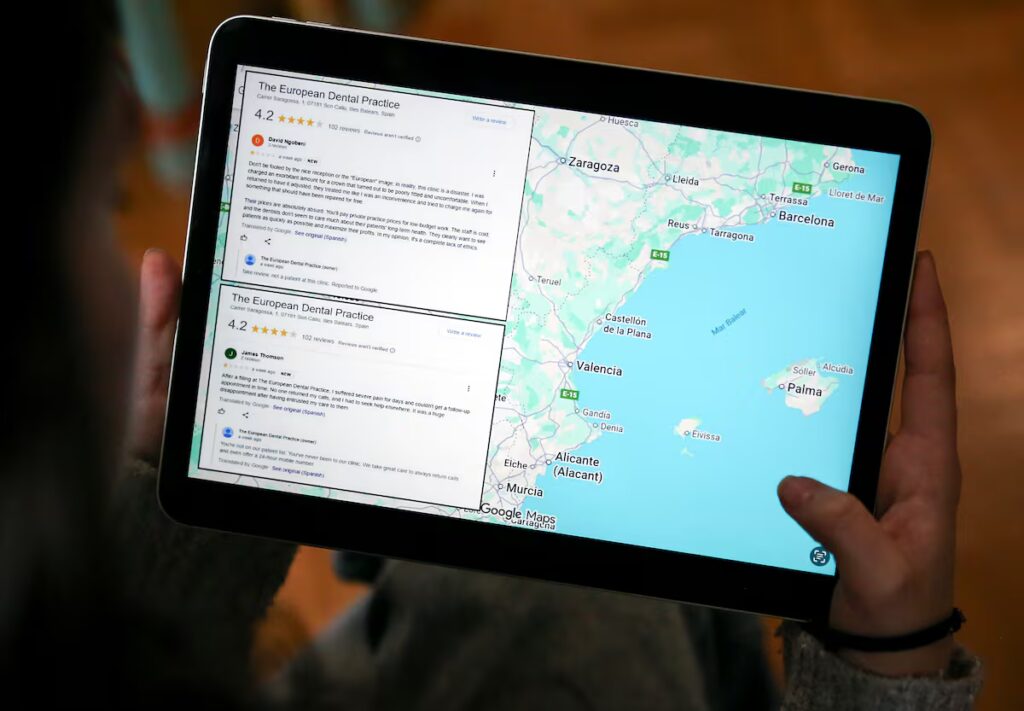
ServiMoving's experience is not an isolated incident. Many businesses across Spain have faced similar fake review attacks. Reports indicate that sectors affected include dentistry in Mallorca, car sales in Alicante, locksmith services in Málaga, and air conditioning installations in Murcia. A common factor is that many of these businesses cater to international clients through English-language websites, yet the fabricated reviews were predominantly written in Spanish. An example included a negative claim that ServiMoving provided “terrible service” and damaged property during a local move.
Knowledgeable Attackers Utilizing AI
Heidi Langkafel from the European Dental Practice clinic in Palma de Mallorca, another business targeted, noted the attackers seemed to have inside knowledge: “They included quite technical details and made alarming claims about our clinic's cleanliness.” This suggests that artificial intelligence may have played a role in crafting the malicious content, as well.
Kay Dean, a former U.S. federal investigator and founder of the YouTube channel Fake Review Watch, has been tracking these extortion schemes globally. She remarked, “Google has become an ocean of fake reviews, both positive and negative, with many negative reviews tied to extortion campaigns.” Dean began her research following a negative experience with a medical provider.
Google's Response to Fake Reviews
Google claims to have removed or blocked over 240 million reviews and more than 12 million fake business profiles since 2024. They have even implemented new methods to combat extortion attempts. However, many business owners claim their experiences suggest otherwise, stating, “Google is very slow to respond, only providing basic automated replies.” Steve, a salesman from Catalexcars in Alicante, echoed these frustrations, as did Sánchez, who mentioned the lack of support left him feeling lost.
As this report was being prepared, some reviews began to disappear, and businesses saw their ratings rebound. In some cases, specific reviews were promptly removed following notifications to Google.
The Burden on Businesses
Critics argue that Google shifts the responsibility to businesses for addressing these fake reviews, causing stress and potential financial losses. Dean noted that while some negative reviews disappear quickly, others can linger for weeks or months. Attackers utilize various tactics, creating profiles that they later close to remain anonymous. Dean has to manually track these profiles and often relies on their mistakes to expose their operations.
While Google occasionally deletes flagged fake reviews, it does not guarantee the removal of all fraudulent reviews from the same profile, leading to concerns that the platform allows deception to persist at the expense of legitimate businesses. “Google has created a lax environment where deception thrives, harming honest companies,” Dean pointed out.
Financial Motivation Behind the Scheme
The motivation for extortionists is clear: if even one out of twenty targeted businesses pays the demanded fee of $200, the scheme proves profitable. Dean revealed that some businesses, despite initial refusals to pay, subsequently fell victim to further fake reviews. “It's a troubling cycle that many businesses are forced to confront,” she concluded.