Table of Contents
ToggleIsabella Rossellini: A Journey from Icon to Innovator
At 73 years old, Isabella Rossellini embodies a unique blend of cosmopolitan sophistication and rural authenticity. Daughter of cinema legends Ingrid Bergman and Roberto Rossellini, she has navigated the complexities of fame and personal challenges throughout her life. Growing up amidst the drama of her mother's high-profile choices, Isabella moved across Europe before establishing her own career in 1970s New York, where she became a fashion and film icon of the ‘80s and ‘90s. As David Lynch's muse and Lancôme's renowned face, Rossellini graced the works of notable photographers like Richard Avedon and Steven Meisel.
Reinvention in Midlife
However, as she approached her 40th birthday, the offers began to diminish. Rather than surrender to this professional drought, Rossellini reinvented herself, immersing herself in the study of animal behavior. She considers this pivot as one of her best life choices.
Today, Rossellini resides at Mama Farm, where she cultivates a diverse environment alongside dogs, sheep, and chickens. Embracing the challenges of aging, she reflects on how this acceptance has enriched her life, leading to a resurgence in both film and fashion two decades later. Her decision to avoid plastic surgery, influenced by long-standing health concerns, has helped her maintain her authenticity.
Balancing Art and Agriculture
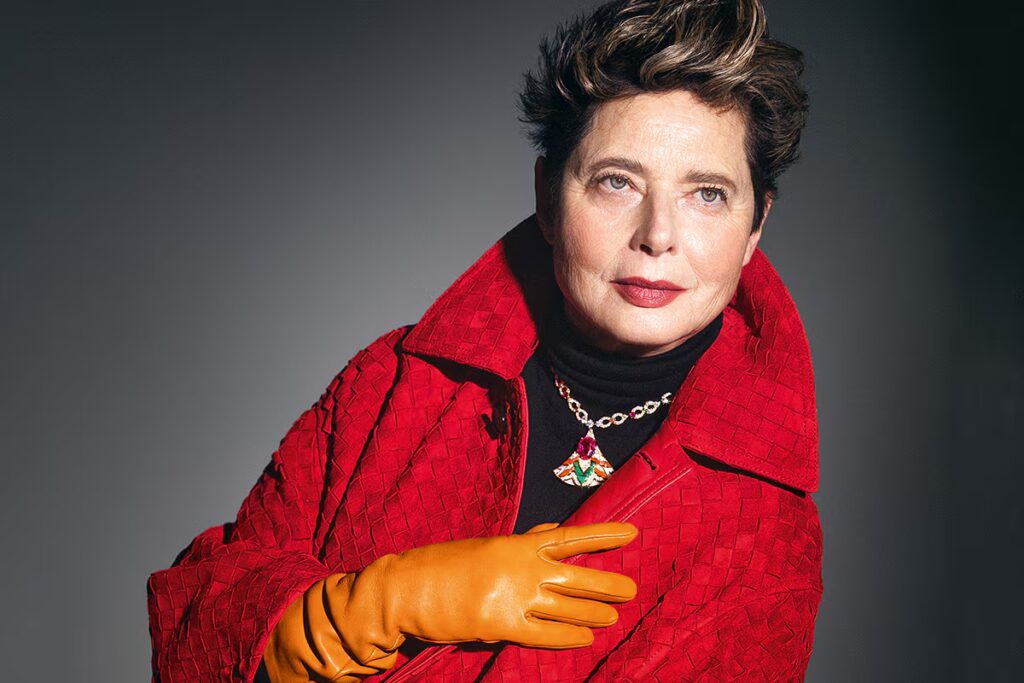
Rustic yet elegant, Rossellini possesses a distinct charm reminiscent of her mother. She gracefully navigates conversations with the same composure she demonstrated as a model. Known for her captivating Italian-accented English, she exudes an enigmatic quality that Lynch expertly highlighted in his work. During a recent photoshoot for Bvlgari jewelry in her Rome studio, she maintained professionalism while skillfully dodging questions about contemporary issues, stating, “I am neither a politician nor a sociologist.”
Roots in the United States
Q: Why did you choose to establish your farm in the United States?
A: I've spent most of my life in the U.S. Born in Rome, I moved to Paris as a child before returning to Italy for my education. At 18, I moved to the U.S. to pursue my studies and eventually started my career. New York became my home; my oldest daughter was born there, and as a single mother, I adopted a son. Although I grew up in multiple cultures, my connection to the U.S. remained strong.
A Personal Commitment to Animals
Q: Was your decision to live on a farm politically motivated?
A: No, it was personal. At 45, with my career waning, I needed to create a new path. My interest in animals led me to join an etiology program at Hunter College, which I found rewarding. Moving to the countryside allowed me to follow this passion.
Q: Do you miss urban life?
A: Not particularly. After 9/11, I wanted a safe space for my son. The city felt too confining for a child, and when a farm property became available, I seized the opportunity. Initially, I aimed to cultivate a small garden, but the community's need prompted me to expand. Mama Farm is now a space where children and families can connect with nature, unaware it would become a community hub.
Challenges and Rewards of Farm Life
Q: Does country living bring you peace?
A: That's a common misconception. Life on a farm is demanding, not a retreat from chaos. Currently, I manage numerous animals and we serve around 150 community members weekly. The workload is intense; the cycles of life are both dramatic and poetic.
Creative Ventures: Exploring Animal Behavior
Q: What inspired Green Porno Live?
A: The concept emerged around the same time as YouTube, aligning perfectly with its vision. Initially crafted independently with limited budget, it gained popularity thanks to support from the Sundance Institute.
Q: Why do you think it resonated with the public?
A: Its brevity fit well with the rising platform of YouTube, allowing my short videos to capture attention and expand from five to 45 installments.
Honoring Her Father's Legacy
Q: This year marks the 80th anniversary of Rome, Open City, your father's iconic film. How do you carry forward his legacy?
A: My siblings and I actively preserve both my parents' archives, collaborating closely with the Cineteca di Bologna for restoration projects. Significant portions of their work are housed both in Italy and the United States.
Q: How do you think your father would view today's world?
A: He endured two world wars, often reminding my children of the resilience he embodied. His lesson is clear: to continue creating and find joy, irrespective of circumstances.
Reflections on Family and Career
Q: As your mother's daughter, how do you navigate the challenges of aging in front of the camera?
A: My mother faced numerous challenges during her career. She continued to work despite industry setbacks, illustrating the resilience that actresses have to cultivate even today.
Q: You received an Oscar nomination for Conclave. Are you going to continue acting?
A: I didn't expect to return to acting. However, I've recently worked on projects including a film about Wallis Simpson and a sci-fi series alongside Ryan Murphy.
Q: Your collaborations with David Lynch are well-known. How do you describe that experience?
A: Working with Lynch is about immersing oneself in a unique world. His films possess an atmosphere that often transcends straightforward narratives.
Looking Toward the Future
Q: How do you perceive the evolution of women's roles in cinema and fashion?
A: I appreciate the progress. If starting today, I might gravitate toward directing, a path unthinkable in my early days. My mother had aspirations in that direction but it was not feasible during her time.
Q: You recently collaborated with Alice Rohrwacher, a prominent female director. How significant is it to work with women in filmmaking?
A: Collaborating with female directors is enriching; their perspectives bring new angles to storytelling that I find compelling. I look forward to future opportunities in this space.
Q: Do you see Rohrwacher as an heir to your father's artistic vision?
A: My father was primarily a humanist filmmaker, focusing on the complexities of human nature rather than political themes.