
Table of Contents
ToggleNvidia's Bold Vision for the Future of AI
As discussions around the generative AI bubble and the ethical concerns of technologies like deepfakes gain momentum, Nvidia, the driving force behind this technological surge, remains steadfast in its mission. The company has recently unveiled a groundbreaking plan to extend artificial intelligence into the physical realm, envisioning robots and self-driving cars capable of human-like reasoning for informed decision-making.
Nvidia's Rise to Prominence
The popularity of ChatGPT ignited trends that positioned Nvidia as the world's most valuable company by 2025, based on market capitalization. CEO Jensen Huang's ambitions, however, extend well beyond merely maintaining this status. In a keynote address at CES—the world's largest technology event held in Las Vegas—Huang emphasized his desire to seize control over the entire AI landscape. Instead of merely supplying complex superprocessors for AI-driven applications, he aims to lead in developing the actual artificial intelligence models utilized in various sectors, including automotive and robotics.
Generative AI: Just the Beginning
At CES 2026, Huang articulated that generative AI represents just the beginning of a new era. Chatbots may have showcased the impressive potential of AI, but they have also attracted the substantial investments necessary for future advancements. “The ChatGPT moment has arrived for physical AI; when machines begin to understand, reason, and act in the real world,” Huang stated.
Next-Generation Superprocessors and AI Models
Nvidia's efforts are centered around its latest superprocessors, named after astronomer Vera Rubin. The company announced that manufacturing of these processors has already commenced, with plans to launch them this year. These advancements promise more cost-effective and energy-efficient AI applications.
In addition to the processors, Nvidia introduced its new AI models, capable of leveraging the five times greater computing power afforded by the Vera Rubin platform. Notably, the Alpamayo model emerged as a groundbreaking open-source visual language framework tailored for training robots and autonomous vehicles.
Human-Like Reasoning in Autonomous Vehicles
Huang proposed that the key to safe autonomous vehicles lies in enabling them to think and reason as humans do. By breaking down complex situations into manageable problems, these vehicles can make decisions based on prior training across a variety of driving conditions and scenarios. Nvidia prepares its models in virtual simulations, under the guidance of human trainers, to ensure they are equipped to operate in real-world situations.
Partnerships and Future Developments
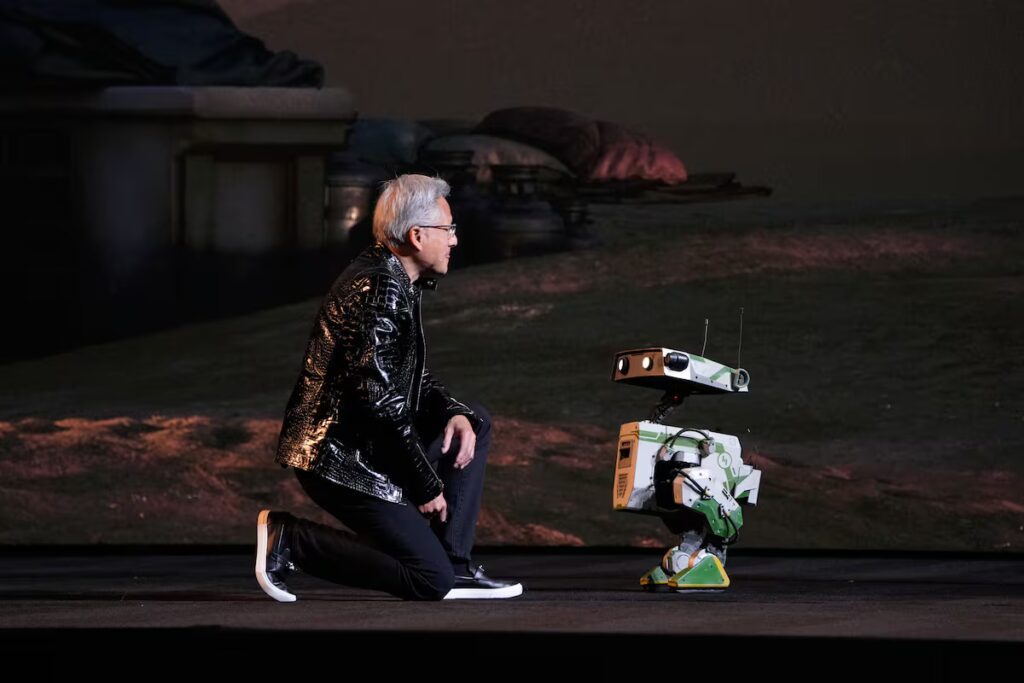
During his presentation, Huang showcased small, engaging robots and unveiled a video of a new Mercedes CLA, set to launch in 2026. Equipped with Nvidia's cutting-edge technology, the car demonstrated autonomous driving capabilities through the streets of San Francisco. This vehicle is the culmination of a collaboration between Nvidia and Mercedes Benz, aimed at producing fully autonomous cars. Following this initiative, Nvidia plans to leverage its technology across the automotive industry, bringing the long-anticipated vision of self-driving cars and trucks closer to reality.