Table of Contents
ToggleThe Origins of Pastrami: From Romania to New York
In the iconic film When Harry Met Sally (1989), a memorable scene unfolds at Katz's Delicatessen in New York City, where Meg Ryan's character fakes an orgasm while her co-star Billy Crystal enjoys a pastrami sandwich. This scene not only heightened the popularity of Katz's but also contributed to an enduring, yet somewhat misleading perception of pastrami. Contrary to popular belief, the method for preparing this meat does not trace its roots back to New York City or, despite its name, to Italy, nor does it induce any culinary or romantic “orgasms.”
The True Roots of Pastrami
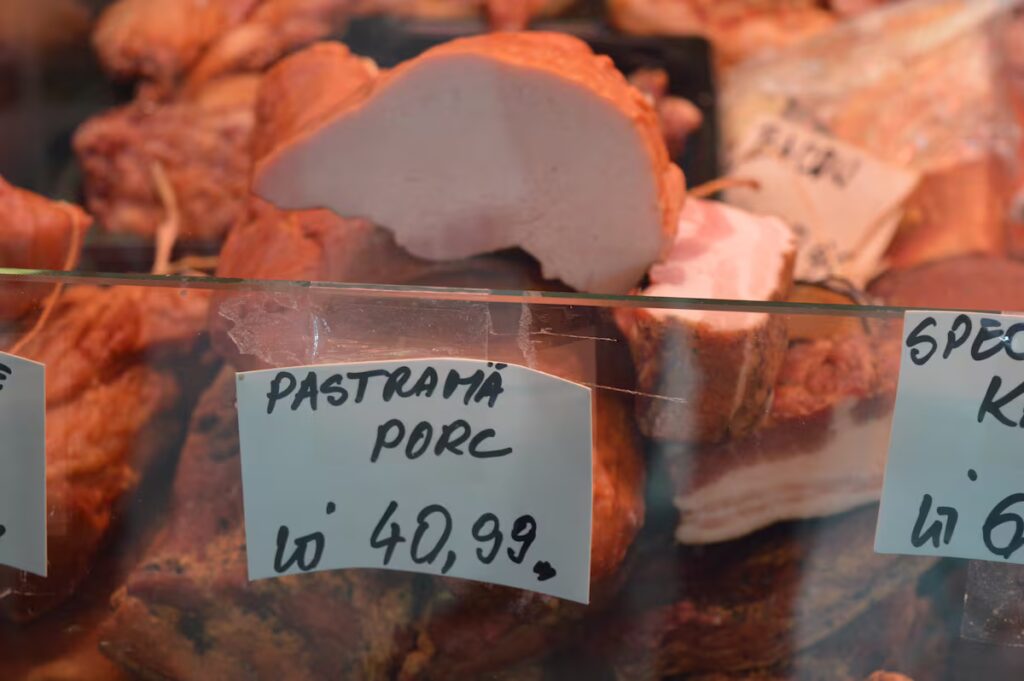
Pastrami actually originated over 4,700 miles (7,600 km) away, in Romania, where it is referred to as pastramă. The term derives from păstra, a Romanian word meaning “to preserve,” and highlights the salting, spicing, curing, and smoking processes that the meat undergoes before consumption. Importantly, the term “pastramă” encompasses various types of meat beyond just beef, including goose, chicken, duck, pork, and lamb. This is particularly evident at the Obor market, Bucharest's largest market, where various meats transform into pastramă, either fresh for cooking or as cold cuts ready to serve.
Pastramă in Romanian Cuisine
In Romanian restaurants, pastramă is typically served in substantial chunks, often accompanied by mămăligă (a cornmeal-based dish akin to bread) and hot peppers, rather than in thin slices between bread as commonly found in the U.S. At Vatra in Bucharest, for instance, diners can relish a stir-fried mutton dish that embodies authentic Romanian flavors. The essence of pastramă lies not only in the type of meat but also in the meticulous process it undergoes.
Traditional Preparation Methods
The conventional Romanian method involves deboning and bleeding the meat, followed by seasoning with a mix of thyme, paprika, pepper, rosemary, basil, and allspice, as per renowned chef Radu Anton Roman's recipe. After a light salting, the meat is either cooked immediately or sometimes smoked. The flavor profile varies based on the meat cut, choice of spices (there are numerous variations), and smoking practices. It was customary in Romania to enjoy sheep pastramă during the grape harvest season, typically served slow-roasted or pan-fried with oil and wine, complemented by mămăligă, cheese, red onion, potatoes, or varză salad (cabbage, a staple in Romanian cuisine).
Immigration and Adaptation in the United States
The tradition of preserving meat was carried to the U.S. in the late 19th century by Romanian immigrants. Research indicates that between 1881 and 1914, about 75,000 Romanian individuals, many of them Jewish from Bessarabia and Bukovina, arrived in New York. Within a short period, pastrami gained traction in several American cities, though it underwent significant alterations. Notably, beef pastrami became prevalent, possibly due to its lower cost compared to other meats. The name “pastrami,” first referenced in writing in 1895, is believed to have been influenced by the existing term “salami,” an Italian sausage popular in the U.S. at the time.
The New York Pastrami Sandwich
Eventually, the rebranded pastrami became a staple of New York delis, commonly served as a sandwich between two slices of rye bread with mustard and accompanied by pickles, cementing its status as an iconic dish. In Romania, however, the recipe stays true to its roots, both in terms of meat variety and preparation techniques. As for the notion that consuming pastrami induces orgasms, real or otherwise, there remains no definitive evidence on either side of the Atlantic.