
Table of Contents
ToggleThe Elegance of Washingtonia Palms
Palms embody a unique elegance characterized by their powerful trunks and attractive leaf crowns that sway gently in the breeze. Each species possesses distinct features that make it easily recognizable among its peers. While many palm species may seem identical to the untrained eye, their differences—particularly in trunk shape and color—become apparent with closer observation.
Overview of Washingtonia Palms
Among the most commonly cultivated palms worldwide are Washingtonia palms, which consist of two primary species. This article focuses on Washingtonia filifera, known for its wide trunk and height of about 20 meters (65.6 ft), and Washingtonia robusta, featuring a slender, tall stem that can reach up to 30 meters (98 ft). Botanical literature also references a hybrid of these two species, called Washingtonia x filibusta. All Washingtonia species are native to California and the Baja California and Sonora regions of Mexico, thriving alongside various types of cacti in these semi-arid climates.
Species Classification
There is a common misconception that only one species exists, Washingtonia filifera, which actually includes two main varieties: Washingtonia filifera var. robusta (the taller variant) and Washingtonia filifera var. filifera. A third variety, Washingtonia filifera var. sonorae, is found in Sonora, Mexico, adding to the classification complexity.
Hardiness and Resilience
The name ‘Washingtonia' pays tribute to George Washington, the first president of the United States. These palms are highly resilient, adapted to survive in environments with fluctuating temperatures, from nighttime frosts to scorching highs exceeding 45°C (113ºF). Once established, Washingtonia palms can endure periods of neglect, with Washingtonia filifera showing remarkable resistance to frost down to -10°C (14ºF) after acclimatization. In contrast, Washingtonia robusta is more sensitive to cold, suffering damage at temperatures lower than -5°C (23ºF).
Distinctive Features
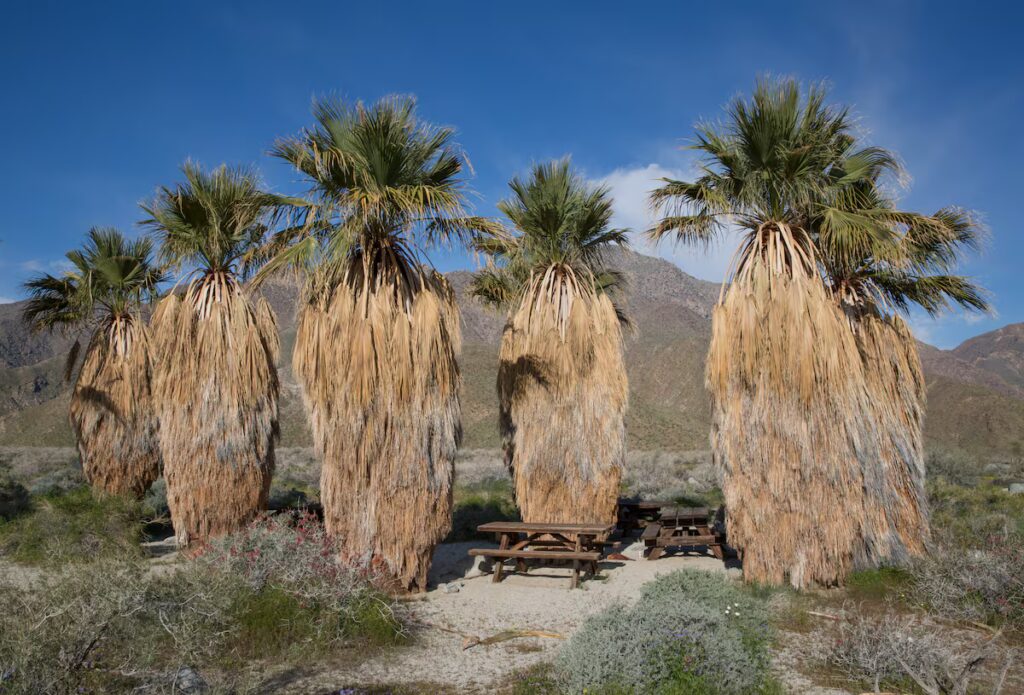
The palmate leaves of Washingtonia palms are notably expansive, with petioles often exceeding one meter in length. These petioles are armed with sharp thorns, necessitating caution when handling. When pruned, their brownish-red bases become visible, adding to their distinctive appearance. Additionally, the lower trunk widens significantly, enhancing stability against strong winds.
The term filifera, meaning “thread-bearing,” describes the fine threads that fray from the edges of the leaves, contributing to the palm's unique appearance. The base of the trunk collects dry, brown leaves, creating a skirt that adds charm. While it's common to prune these older leaves, retaining some can enhance the palm's aesthetic character.
Flowering and Seed Dispersal
Washingtonia palms produce small, creamy flowers in long clusters between late spring and mid-summer. Though their height often keeps them out of direct view, these flowers yield hundreds of seeds encased in sweet, pulpy material, reminiscent of date fruits (Phoenix dactylifera). The seeds germinate rapidly, often sprouting in sidewalk cracks or at the base of walls, making it easy for young Washingtonia palms to emerge in ideal growth conditions.
The germination process occurs within one to two months, offering a fun and educational activity for families or classrooms. By nurturing these seedlings, a piece of the American semi-desert regions can be cultivated right at home.