
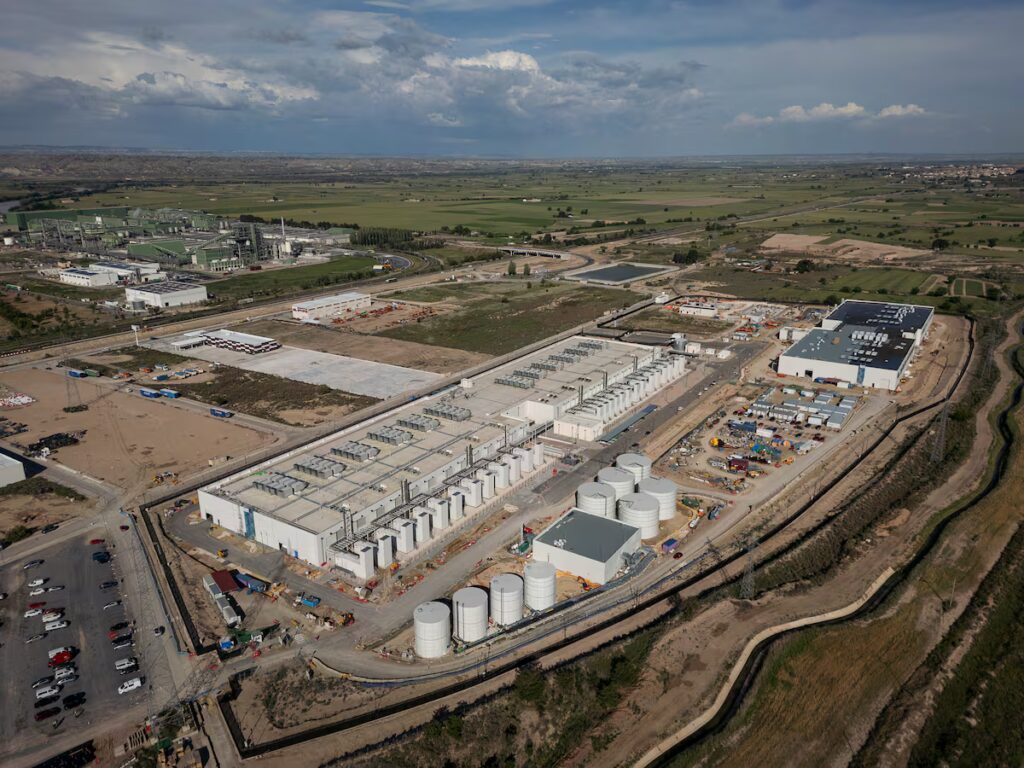
The combination of a stable social peace based on a lasting political pact, significant bureaucratic efficiency, and the geographic advantages of Aragon promotes the establishment of technology areas, generating a vital ecosystem for the digital economy.
The high-speed train travels at around 200 kilometers per hour towards Zaragoza, with the journey lasting just over 60 minutes. As it nears its destination, the landscape features clay cliffs, olive trees, and fog clinging to mountain ridges. The surrounding area is a logistical hub, but Aragon is more than that; it has become a focal point for data centers. This development correlates with a decrease of 48,000 unemployed individuals this year, as the autonomous community has embraced these spaces as technological transformation tools. The presence of major platforms, such as Amazon, has provided a new visibility to this land historically associated with agriculture and logistics.
Part of this success is attributed to education. The event organized by Retina, supported by Santander, with Google as the annual partner and AWS (Amazon Web Services) sponsoring, highlights this. According to Julio Tejedor, a legal expert and professor of Administrative Law at the University of Zaragoza, “Universities are a tool for society, and if they are not, something is wrong.” He emphasizes the need for academia to connect with the school system. For the 2024-2025 academic year, for the first time in Aragon, there will be more graduates from Vocational Training (FP) than from universities. This shift was made possible by Amazon.
Table of Contents
ToggleDiverse Generation
Constructing data centers using renewable sources often leads to excess energy that could be exported. The indirect employment generated through their creation or maintenance is also significant. Furthermore, due to their low latency, these centers are ideal for autonomous or connected vehicle companies. Esther Borao, General Director of the Technological Institute of Aragon (ITA), predicts a “silent revolution” fueled by microelectronics, data, artificial intelligence, and algorithms.
Aragon has 1.368 million inhabitants, with 700,000 residing in Zaragoza. Borao mentions the potential for small projects to reach interior communities, such as the transportation of a robot to inspire innovation. They have launched initiatives for entrepreneurs, secured European Union funding, and even created a currency (referred to as magnets) to encourage creativity. Borao suggests that this methodology can help create larger projects that engage more companies.
Underlying this progress is a legislative framework that supports local communities in partnerships with large corporations. Tejedor emphasizes the importance of transparency and community engagement in the authorization processes for such large projects. Effective dialogue is vital, he states, in addressing local concerns regarding these developments.
Why has Amazon chosen this region to deploy its infrastructure? The answer lies in resource availability. Data centers need energy to transform into computational capacity, fostering innovation. According to David Blázquez, head of Public Relations for Infrastructure, Energy, and Sustainability at AWS, the capacity for growth presents an opportunity for Aragon and other regions in Spain.
Unified Efforts
Additionally, a unique social peace exists in Aragon—a sort of consensus among all political parties since 2009, allowing the evolution of supramunicipal projects into a formal Territorial Planning Law. Those leading institutions have recognized that Aragon is crucial for both physical goods logistics and data logistics.
Amazon's project was initially approved in December 2019 and received final approval in July 2021, navigating even through a pandemic while the administration maintained its collaboration with the company. This illustrates that Aragon has activated its technological trajectory irrespective of political shifts.
As this region continues to pivot towards technology, the transformation echoes lessons from economic fundamentals—selling processed goods instead of raw materials. The focus is on enhancing the value of energy consumption by turning it into information capacity, laying the groundwork for a robust technological ecosystem.
Water consumption and environmental impact remain an ongoing debate, often more emotive than energy consumption due to its geographical ties. The most efficient cooling methods for data centers can be derived from clever strategies that prioritize sustainability. In recent years, Aragon has successfully shown that innovation and sustainability can coexist.
Javier Martínez: “Social peace is vital for attracting large projects”
Aragon has evolved into a hub for cutting-edge technologies, understanding that data drives the revolution in industries, reminiscent of the transformation initiated by General Motors in the 1980s. Javier Martínez, General Director of Economic Policy for the Government of Aragon, asserts that this revolution is inclusive, impacting all sectors.
Challenges remain, particularly in integrating small businesses into this technological landscape. It is crucial that no entity feels excluded, maintaining a harmonious relationship across political lines. The governmental strategy involves transforming its administrative structure into a cohesive body that can efficiently coordinate project implementation.
Moving forward, Aragon looks to the future, contemplating its path toward 2035 and beyond. Stability, talent retention, and public-private collaboration are essential for transforming Aragon into a destination for opportunities rather than a transit point towards other regions. The establishment of new clusters and collaborations reflects Aragon's ambitions in technology and innovation.