
Medieval monasteries in Emilia-Romagna share an intriguing connection with a local bank established in 1910: both have incorporated food preservation into their daily operations. Throughout history, monks and bankers have sought to capitalize on a remarkable product—cheese that retains its quality over years while increasing its value as it ages. This food, critical for monastic survival in the 12th century, has evolved into a vital part of Italy‘s culinary heritage. It even caught the attention of Harvard Business School for its unique financial application.
Table of Contents
ToggleCredem's Unique Loan System
What sets this financial model apart is that Credem, the bank in question, accepts wheels of cheese as collateral in loan agreements with producers. The bank grants loans ranging from 60% to 80% of the cheese's value, storing the collateral in its own warehouses. If a producer defaults, the bank recovers its investment by selling the aged cheese. These warehouses collectively store cheese worth an estimated €325 million ($378 million), underscoring the product's economic value and exceptional culinary reputation. The cheese serving as collateral is Parmigiano Reggiano, a product celebrated worldwide.
The Global Reach of Parmigiano Reggiano
Parmigiano Reggiano stands as one of Italy's most iconic foods and serves as a leading ambassador for Italian cuisine globally. The cheese's taste and characteristics are better recognized internationally than the specific regions of Parma, Reggio Emilia, Mantua, Bologna, and Modena—where it can legally be produced under its name. Nearly 84,000 tonnes of this cheese are exported annually, demonstrating its deep ties to the culture, tradition, and territory of these five provinces. The cheese has held Protected Designation of Origin (PDO) status for 30 years due to its unique qualities and the prevalence of imitations.
Counterfeiting Challenges
In Europe, PDO certification protects Parmigiano Reggiano's origin, ingredients, and production methods, preventing similar cheeses from using misleading labels such as “Parmesan-style.” However, outside the European Union, the situation varies drastically, leading to Parmigiano Reggiano being one of the most counterfeited foods globally. The imitation market is valued at over €2 billion ($2.3 billion).
“The phenomenon of imitations is particularly prominent in North America, Latin America, and parts of Asia, where ‘Parmesan' often generically refers to various hard cheeses,” explains Fabrizio Raimondi, communications manager for the Consorzio del Parmigiano Reggiano. Imitation products attempt to evoke the classic cheese without adhering to its stringent PDO specifications, ultimately affecting both producers' reputations and consumers' experiences.
The Art of Cheese-Making
The recipe for Parmigiano Reggiano has remained unchanged for nearly a millennium. It takes 520 liters of raw milk to create a single wheel of cheese, which initially weighs around 50 kilograms but diminishes as it matures. The cheese is made using calf rennet and salt; the latter is vital for moisture reduction and preservation. The cheese is soaked in brine for three weeks, with salt penetrating slowly—taking nearly a year to reach the center. Thus, the fourth essential ingredient is time.
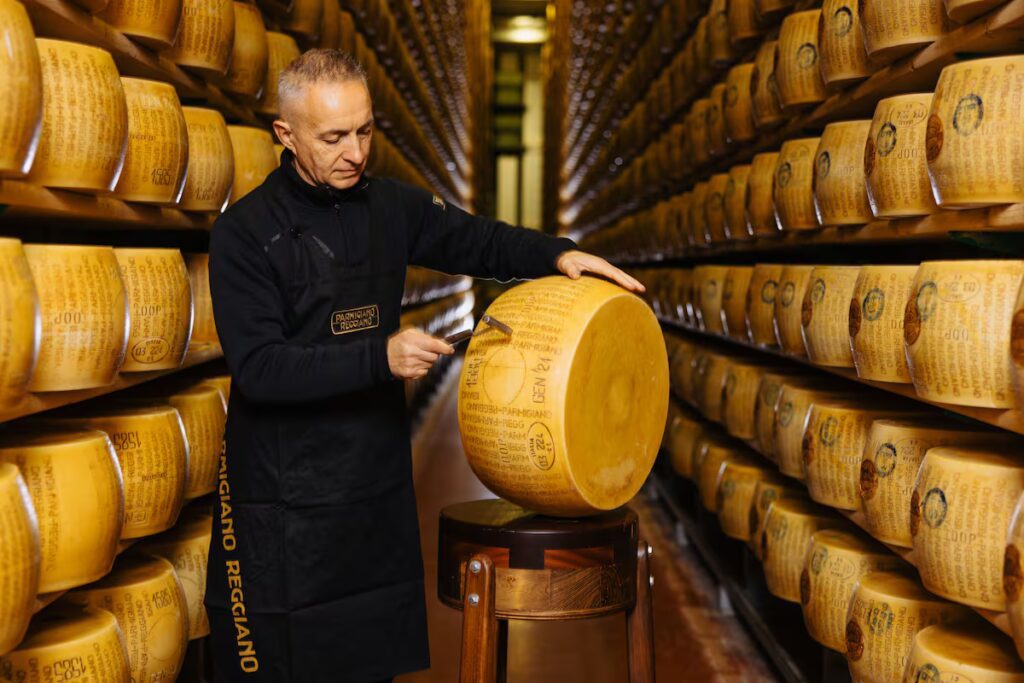
The wheels of cheese rest on wooden racks for a year before a quality inspection occurs. An expert taps the cheese rind with a hammer, listening for the right sound. If no external or internal defects are found, the cheese is branded with a quality seal before it continues aging. The versatility of Parmigiano Reggiano allows it to complement high-end cuisine, wines, cocktails, and even desserts.
Tradition Meets Innovation
Different aging periods yield distinct flavor profiles, ranging from creamy and mild in younger cheeses to complex, intense, and umami-rich in aged varieties. The standard aging times are 23, 36, and 40 months, with some exceptional wheels maturing for up to 100 months. Interestingly, the oldest varieties are often the most innovative.
Master cheesemakers play a crucial role in production, inheriting skills that combine technical knowledge and hands-on experience passed down through generations. Many Parmigiano Reggiano producers are family-run or small artisanal businesses, emphasizing a strong commitment to quality.
The cheesemaker's job involves working with a living, natural product, where milk quality fluctuates due to seasonal changes and the cows' diet. Parmigiano Reggiano's distinct identity is rooted in its territory, with local forage contributing unique microbiological characteristics to the milk.
Promoting Local Tourism
To further enhance this identity, the Consorzio del Parmigiano Reggiano has initiated a tourism project that showcases local farms, dairies, and gastronomic experiences, aiming to increase annual visitor numbers from 85,000 to 300,000 by 2029.
Currently, the authenticity of places like Parma is palpable, with traditional food shops dominating the landscape over souvenir stores. These establishments highlight the rich offerings of Parmigiano Reggiano, providing genuine treasures for the culinary enthusiast.