Microsoft spent years packing Nvidia GPUs into Azure to train and serve the models behind Copilot and OpenAI. On 12 October 2026 that story took a decisive turn. Executive Vice President Scott Guthrie announced Maia 300, the company's third-generation custom AI accelerator, and said Azure Maia will scale to multi-gigawatt deployments starting in 2027 as the primary inference system for Microsoft products and services. The claim is not that Nvidia disappears from Redmond's datacenters. It is that the economics of serving tokens at cloud scale now favor silicon Microsoft designs itself. For anyone following hyperscaler Technology strategy, that distinction matters.
Guthrie's post and a companion Azure architecture deep dive laid out a clear product roadmap. Maia 200 is already in production across the United States, Europe and Australia, running OpenAI models, Microsoft's own MAI models and leading open-source families for workloads that include Microsoft Copilot. GitHub Copilot and Microsoft Foundry are scheduled to follow by the end of 2026. Maia 300, the third generation after Maia 100 (2023) and Maia 200 (announced January 2026), enters production deployments in 2027.
The headline efficiency numbers are aggressive. Microsoft expects Maia 300 to deliver 40% more tokens per megawatt than leading GPU-based systems, and up to seven times the rack-scale token throughput of Maia 200 in a full 96-accelerator configuration. That rack packs 96 accelerators inside a 167-kilowatt power envelope, with 27.6 TB of HBM capacity and 1.7 PB/s of aggregate HBM bandwidth across a high-speed scale-up domain — double the accelerator density of Maia 200, according to both Guthrie and CNBC's reporting.
The workloads Maia 300 targets are not yesterday's chatbots. Guthrie framed the system around long-context reasoning, latency-sensitive conversational experiences and sustained, multi-step agentic tasks — the same profile Microsoft AI CEO Mustafa Suleyman cited when he told The Verge that catching up with Google DeepMind, OpenAI and Anthropic requires co-design “all the way down to the silicon.”
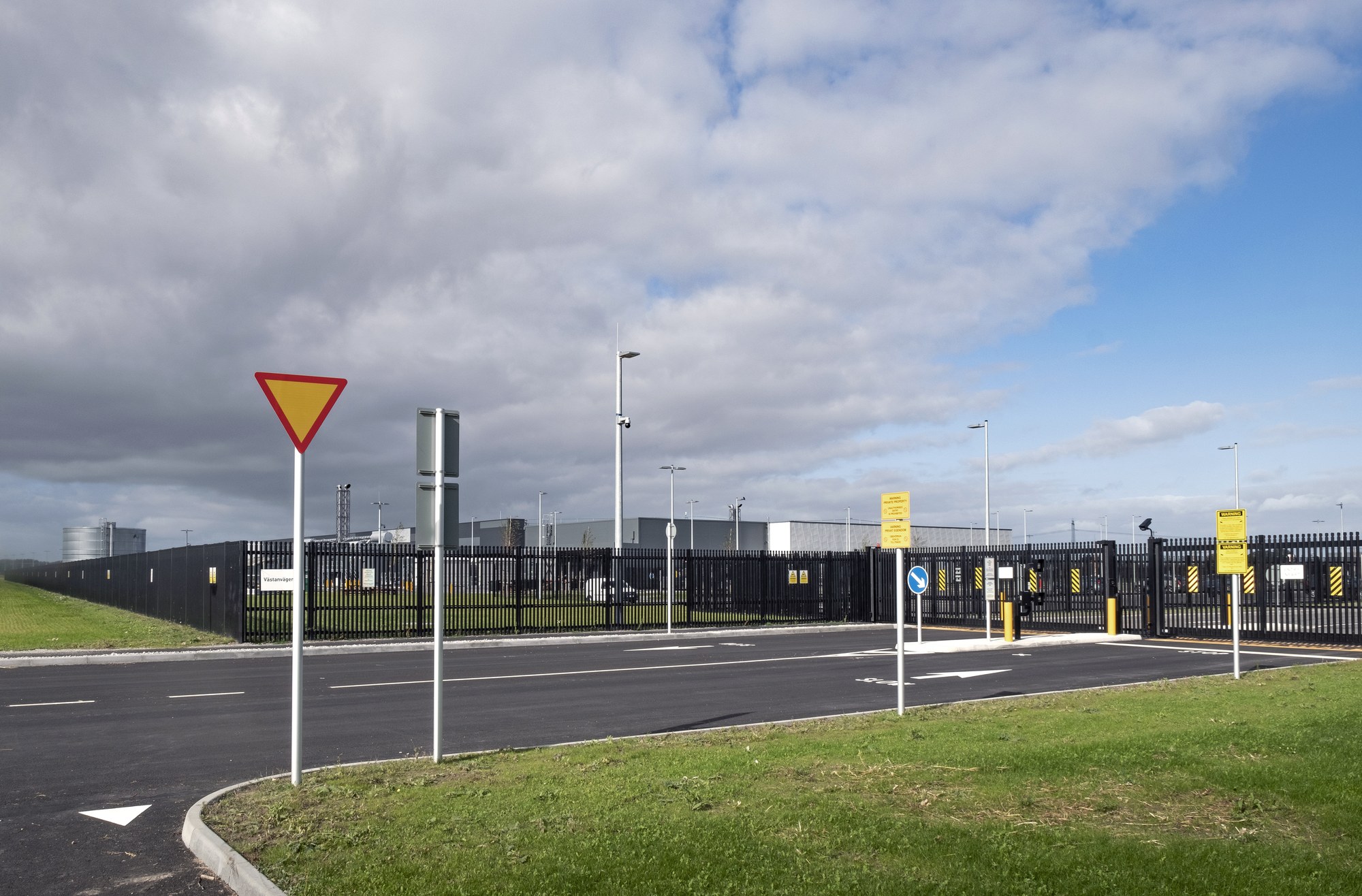
Microsoft datacenter construction in Staffanstorp, Sweden — part of Azure's European footprint already running Maia 200 production workloads. Photo: Johan Wessman / News Øresund, CC BY 2.0, via Wikimedia Commons.
From Maia 100 to Maia 300: Building an Inference Stack
Custom accelerators are no longer exotic in cloud. Google has TPUs; Amazon has Inferentia and Trainium; Meta and others have poured capital into internal silicon. Microsoft's path has been quieter and, until this week, more cautious. Maia 100 debuted in 2023 as a first generation. Maia 200 followed in January 2026; by July, CEO Satya Nadella told analysts it delivered “30% better performance per dollar than the latest generation hardware in our fleet” and was already handling OpenAI models.
Guthrie now says Maia 200 is the best-performing AI infrastructure in Microsoft's fleet on real-world service metrics, delivering up to 1.7 times more tokens per watt for built-in AI in Teams, Copilot and Cowork experiences compared with leading GPU infrastructure. That production feedback loop — silicon teams watching how Copilot, Dragon Copilot and Foundry actually burn tokens — is what shaped Maia 300's inference-first architecture.
Finance chief Amy Hood, speaking at a Goldman Sachs conference in September 2026, underscored a broader point: years of using Microsoft's own CPUs alongside Intel and AMD silicon have already driven “margin improvement over the course of a decade.” Maia extends that logic from general-purpose compute into the AI accelerator layer, where power and CapEx pressure are fiercest.
Architecture: Chiplets, HBM4, and Software-Defined Dataflow
The technical paper and Azure blog make the design choices explicit. Maia 300 uses a multi-chiplet package that separates compute, memory-controller and I/O functions. Compute chiplets sit on TSMC's N2P process to maximize performance per watt; other dies optimize for bandwidth, connectivity and cost. Microsoft says this strategy increases system compute FLOPs by 36%, adds 2.5 times HBM bandwidth and provides 14% more scale-up bandwidth versus Maia 200.
Memory is the other pillar. Each accelerator carries eight HBM4 stacks providing 288 GB of capacity and 18.0 TB/s of peak bandwidth within a 950-watt TDP — roughly 2.5 times the memory bandwidth, 33% more capacity and about twice the HBM bandwidth per watt of Maia 200. Specialized kernels treat on-die SRAM as a software-managed scratchpad to reduce pressure on HBM. Narrow-precision formats, including enhanced MXFP4 and sub-3-bit storage, shrink KV-cache and weight footprints so longer contexts and more concurrent sessions fit inside the same power envelope.
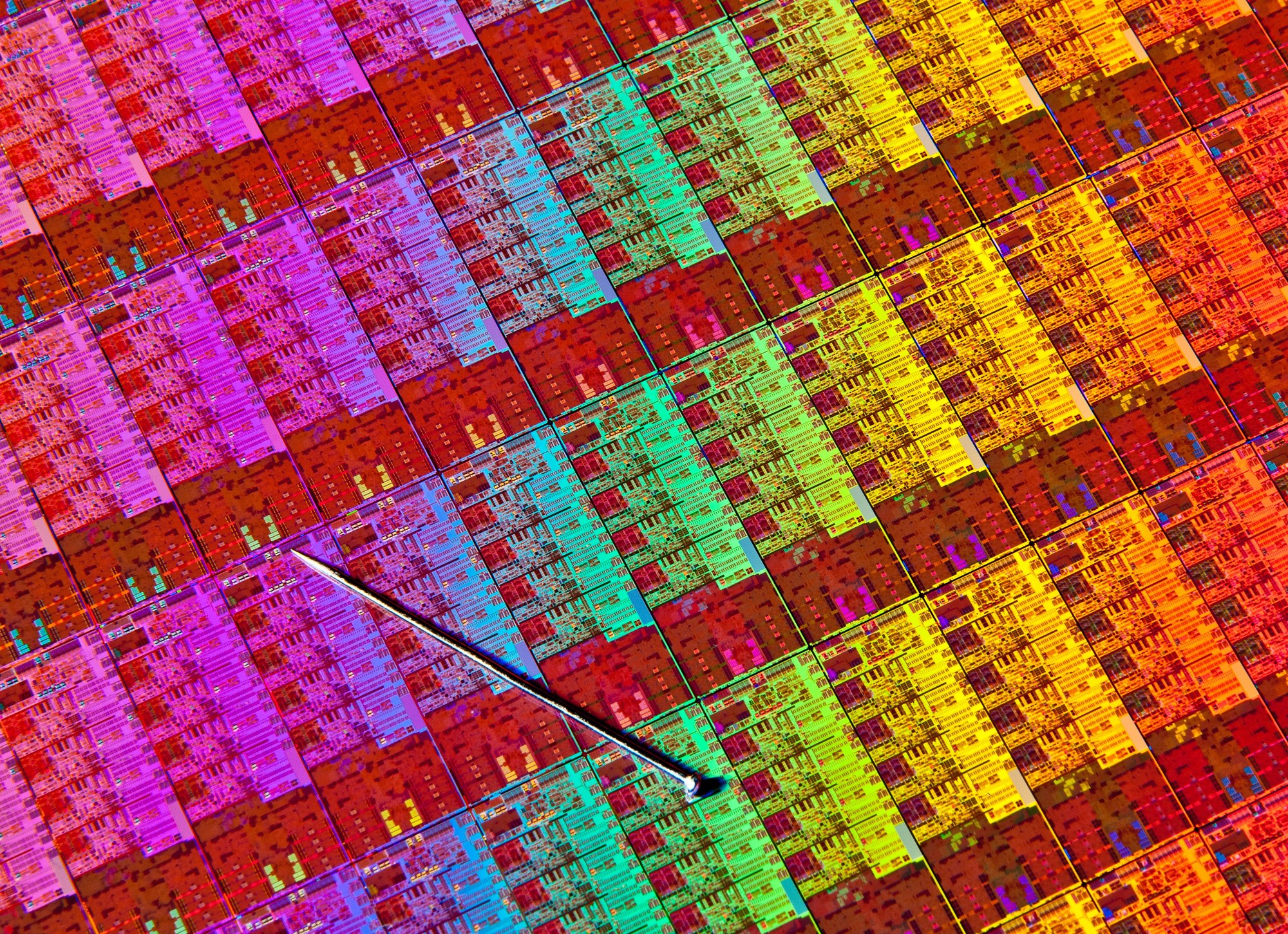
A silicon wafer with a finished chip — a reminder that Maia 300's N2P chiplets and HBM4 stacks still depend on advanced foundry and packaging supply. Photo: Intel Free Press, CC BY 2.0, via Wikimedia Commons.
Underneath sits what Microsoft calls Software Defined Locally Accessed Dataflow Architecture (SDLA): control and data paths are separated so software can place and move data across local memories, DMA engines, compute and the network. Maia 300 moves from uniform memory access to a locality-aware NUMA layout across chiplets. Networking is treated as an extension of that dataflow. A two-tier Ethernet-based fabric builds a “superpod” of up to 12,288 accelerators; each accelerator can drive up to 750 GB/s to peers within that domain. Prefill and decode workers can be sized and placed independently, with KV state moving directly over the scale-up fabric rather than through a host-mediated scale-out path.
At the rack, liquid cooling removes more than 80% of thermal load from accelerators, voltage regulators and switch ASICs. Dual power feeds, a 50 V busbar and an integrated rack automatic transfer switch support service without taking the whole rack offline. The goal is not a prettier demo board; it is more useful tokens inside a fixed datacenter power and cooling budget.
Why Inference Matters More Than Training Right Now
Training still grabs headlines — trillion-parameter runs, multi-week jobs, exotic interconnects. But the bill that keeps growing for hyperscalers is inference: every Copilot reply, every agent step, every Foundry deployment that stays warm for customers. decode-heavy, long-context and tool-using agents change the arithmetic intensity of the workload. Memory bandwidth and data locality often matter more than peak FLOPs.
That is why Microsoft keeps stressing tokens per megawatt and tokens per dollar rather than a raw tops figure. Power translates directly into operational cost, as Azure hardware general manager Alistair Speirs told CNBC. Packing 96 Maia 300 chips per rack — versus 48 for Maia 200 — is as much a facilities decision as a chip decision. Evercore ISI, in a note cited by CNBC, estimated Maia could represent about 10% of Microsoft's AI chip spending by the first quarter of 2027. That is still a minority share, but it is no longer a science project.
Jim Kleewein, a Microsoft 365 technical fellow, said parts of Microsoft 365 Copilot should speed up on Maia 300. Dragon Copilot is positioned to reduce clinicians' administrative burden with lower-latency interactions. The product story and the silicon story are meant to reinforce each other: co-design the models you own with the accelerators you own.
Nvidia Still Matters — But Optionality Is the Strategy
Nobody serious expects Microsoft to eject Nvidia. Speirs was explicit that training still partners with Nvidia and AMD. Jensen Huang appeared at a Microsoft Surface event only days before the Maia 300 unveil. Azure will keep selling GPU capacity to customers who need it. Unlike Google TPUs or Amazon Inferentia and Trainium, Maia accelerators are not yet offered for rent by the hour; Patrick Moorhead of Moor Insights and Strategy noted to CNBC that “nobody has tested them outside of Microsoft yet.”
The strategic point is optionality. When demand for AI compute outruns foundry and packaging capacity, buying only one vendor's roadmap is a concentration risk. Homegrown silicon lets Microsoft tune for its own agentic and Copilot traffic, protect margins, and negotiate from a stronger position. It also aligns with a wider industry pattern: Broadcom financing custom OpenAI accelerators, Amazon and Google deepening internal stacks, and foundries chasing advanced packaging for AI. Microsoft's twist is to keep an open, heterogeneous platform for customers while making Maia the default path for its own first-party inference.
There are caveats. Production starts in 2027, not tomorrow. Multi-gigawatt Maia deployments are a target, not a booked order book; Speirs declined to give a firm timeline and stressed “optionality” as models and silicon choices keep shifting. Software maturity, yield on TSMC N2P chiplets, HBM4 supply and datacenter liquid-cooling readiness will decide how fast the 40% tokens-per-megawatt claim shows up in Azure's cost curves. And external customers cannot yet A/B-test Maia against GPUs on the same workload — a gap that matters for credibility outside Redmond's walls.
What Multi-Gigawatt Maia Means Next
If Microsoft hits even a fraction of the multi-gigawatt ambition, inference economics inside Azure change. More Copilot and Foundry capacity per megawatt means either lower unit costs, more features for the same power bill, or both. Competitors will read the same memo: the next battleground in cloud AI is not only who trains the flashiest model, but who serves useful tokens cheapest and most reliably under a constrained power envelope.
Microsoft Ignite 2026, scheduled for next month in San Francisco and online, is the next checkpoint Guthrie flagged for strategy and adoption detail. Until then, the Maia 300 announcement is best read as a systems declaration. The chip matters. The rack, the fabric, the cooling and the co-design with MAI models matter more. Homegrown Semiconductors will not replace Nvidia overnight — but they are no longer a side project in the world's largest software company.
Filed under: Artificial Intelligence, Semiconductors, Microsoft, Computing, Chip.
To provide the best experiences, we use technologies like cookies to store and/or access device information. Consenting to these technologies will allow us to process data such as browsing behavior or unique IDs on this site. Not consenting or withdrawing consent, may adversely affect certain features and functions.
Functional
Always active
The technical storage or access is strictly necessary for the legitimate purpose of enabling the use of a specific service explicitly requested by the subscriber or user, or for the sole purpose of carrying out the transmission of a communication over an electronic communications network.
Preferences
The technical storage or access is necessary for the legitimate purpose of storing preferences that are not requested by the subscriber or user.
Statistics
The technical storage or access that is used exclusively for statistical purposes.The technical storage or access that is used exclusively for anonymous statistical purposes. Without a subpoena, voluntary compliance on the part of your Internet Service Provider, or additional records from a third party, information stored or retrieved for this purpose alone cannot usually be used to identify you.
Marketing
The technical storage or access is required to create user profiles to send advertising, or to track the user on a website or across several websites for similar marketing purposes.