
Table of Contents
ToggleAmazon's Successful Satellite Launch: A Milestone for the European Space Industry
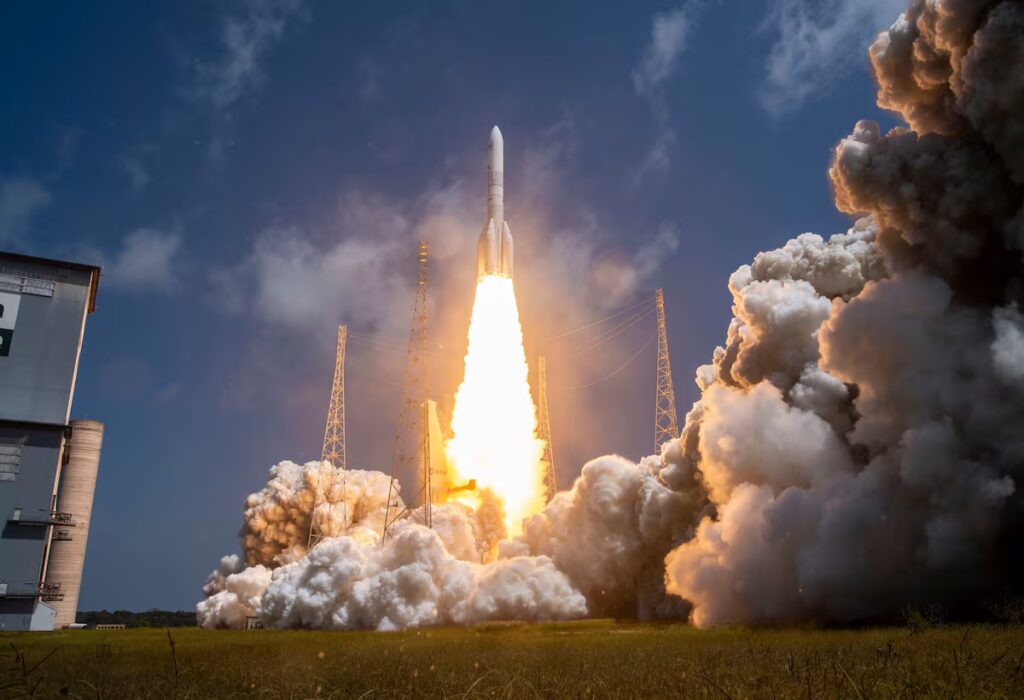
The recent launch of 32 Leo satellites by Amazon from the European Space Center in Kourou, French Guiana, marks a significant achievement in the ongoing competition between industry giants Elon Musk and Jeff Bezos. This successful deployment not only showcases economic viability for the European space sector but also emphasizes technological sovereignty.
Growing Significance of the European Space Economy
In a 2023 statement at an event in Seville, Josef Aschbacher, Director General of the European Space Agency (ESA), emphasized the urgent need for Europe to participate in the growing space economy. He noted, “The space economy is growing. Not participating in this would be strategically very difficult to justify. We have missed the boat.” This call to action set the stage for renewed efforts in commercial space ventures.
Amazon's Entry as a Major Client
The launch from Kourou, occurring three years after Europe's strategic shift, demonstrates how quickly the continent has regained ground in the space race. The Ariane 6-4 rocket successfully transported the Leo satellites into orbit, making Amazon the first commercial client of the European space industry with nearly one hundred new launches contracted.
Caroline Arnoux, business unit director of the Ariane rocket, expressed pride in the company's burgeoning success, stating that the Ariane program has evolved from government projects to include major commercial clients like Amazon.
Proof of Economic Viability
Louis Laurent, head of the Ariane 6 program, stated, “The launch is proof that it is a business.” He highlighted that launching 22 tons into space can cost between 200 and 250 million euros. Laurent remarked on the critical role satellites play in everyday life and emphasized the strategic importance of the Leo deployment, marking it as the first purely commercial mission.
Technological Independence and Innovation
The Ariane program has also contributed to Europe's independence in satellite deployment. Laurent pointed out that the program has successfully sent various critical instruments into space, including the European GPS known as Galileo. This achievement underlines Europe's solid presence in the global space arena.
Lisa Scalope, consumer director at Amazon Leo, highlighted the economic impact of the satellite constellation, predicting it will contribute €2.8 billion to the European GDP by 2029 and sustain 3,270 jobs annually.
Technical Advancements in Rocketry
The launch of the first version of the Ariane 6, the largest and most powerful rocket ever developed by ESA, represents a significant technological step forward. This state-of-the-art rocket, capable of carrying up to 21.6 tons into low orbit, has successfully progressed to version 4, enhancing its load capacity.
Philippe Clar, director of civil launches for the Ariane group, described the Ariane 6-4 as comparable to a “heavy launcher” in terrestrial terms, capable of transporting substantial payloads. Future improvements, including enhanced engines and propulsion systems, are set to further boost its performance.
Addressing New Defense Requirements
The Ariane program is not just advancing in commercial space; it is also adapting to new defense needs, which are critical for navigation, surveillance, and communications, according to Laurent.
Maintaining Autonomous Access to Space
The launch has reaffirmed Europe's autonomous access to space, providing the capability to handle both small and large payloads across various orbits. Toni Tolker-Nielsen, Director of Space Transportation at ESA, noted that the collective rocket fleet, including Vega-C and both versions of Ariane 6, exemplifies Europe's comprehensive space transportation capabilities.
Aschbacher, reflecting on the successful mission, expressed a commitment to continuous improvement: “Our rocket fleet is complete, but we won't stop there. Improvements are already underway for future releases, starting with the launch of our planet hunter Dish, which is set to use an upgraded Ariane 6.