
Table of Contents
ToggleEuropean Commission Proposes Regulation for Minors’ Access to Social Networks
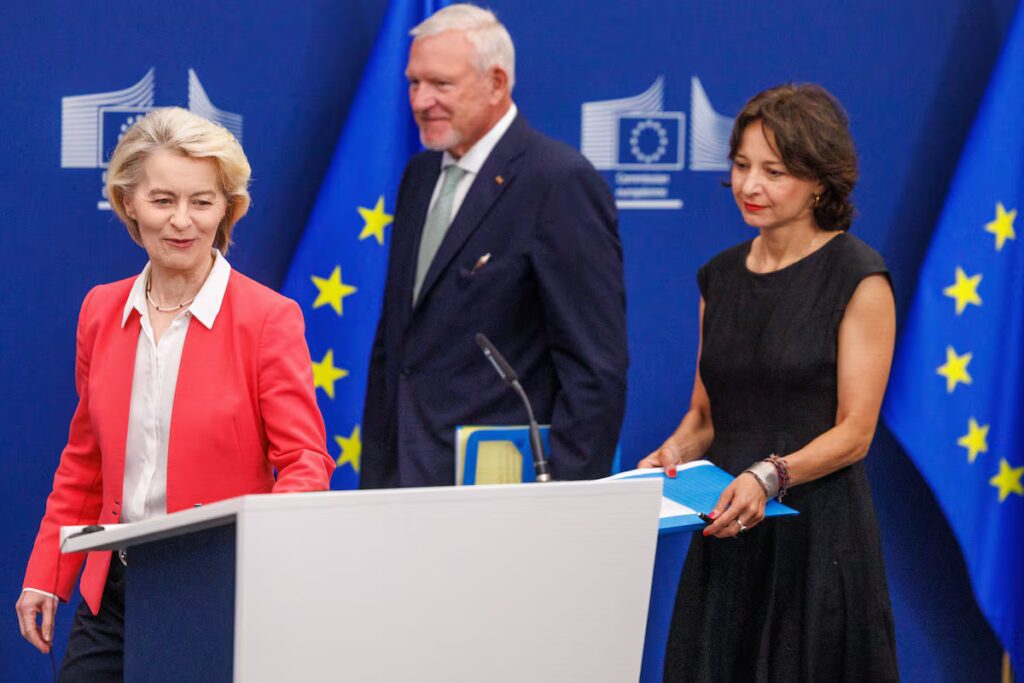
The European Commission is taking significant steps toward regulating minors’ access to social networks. On Monday, it received a report from a panel of experts appointed in March, which recommends limiting access to social networks for children under the age of 13 and gradually easing restrictions until the age of 18. President Ursula von der Leyen has described this “gradual” approach as “convincing.” However, the formal proposal is expected to take a few more months to be introduced, with von der Leyen indicating that the document will be presented “after the summer.”
Child Safety on the Internet
During the presentation of the report, von der Leyen drew analogies to common safety practices: “Just as we do not hand car keys to our children without a driver’s license or allow them to buy alcohol until they reach the appropriate age, we need to establish a minimum age for accessing social networks.” She emphasized that children should not have screen time before the age of three and should only access social networks under the supervision of parents, caregivers, or teachers, and for limited durations. The report advocates for a “gradual access” model to ensure child safety during this critical phase of brain development.
Responses from Member States
The report was prompted by rising concerns from several EU Member States that are drafting laws to set a minimum age for access to social networks and other digital services that could expose minors to risks. For instance, France has proposed a 15-year limit based on a list of restricted services. Sweden is also considering similar restrictions, while Greece focuses specifically on social networks. Spain, Portugal, Germany, Poland, and other EU members have expressed intentions to implement comparable measures.
Avoiding Fragmentation of Digital Services
Experts Jörg M. Fegert and Maria Melchior, authors of the report, warn that inconsistent regulations among Member States could lead to a fragmented European digital market, resulting in varying levels of protection for minors. To counter this, the report suggests establishing a harmonized minimum age. This includes a total ban on screen use for children under three, and strictly supervised access for children aged three to 13, with parental oversight and time limits.
Transitioning to Autonomous Use for Teenagers
For adolescents aged 13 and older, the report proposes a shift towards a more autonomous model. However, it emphasizes that teenagers should only use age-appropriate, secure social media platforms equipped with essential safety features, including limitations on infinite scrolling and recommendation systems. These recommendations are in line with recent decisions by the Commission regarding modifications to features on platforms like TikTok, Instagram, and Facebook, aimed at reducing addictive tendencies.
Reversing the Burden of Proof
To create safer online environments for minors, the report suggests that the burden of proof should be reversed. Instead of the responsibility lying with users or their supervisors to prove that a platform is unsafe, technology companies must demonstrate that their services are safe. This principle aligns with existing regulations in the Digital Services Act (DSA) but extends further. The report advocates restricting access to those under 13 years of age unless firms can prove their services are designed with safety in mind.
Age Verification Systems
The report also underscores the importance of effective age verification systems, an area identified as lacking in various investigations led by the European Commission under the DSA. Notable issues have been observed on adult sites like Pornhub, Stripchat, XNXX, and XVideos, which have been criticized for inadequate measures to prevent minors from accessing their content. Similar findings have been noted with platforms like Meta and Snapchat.
Support from the European Parliament
The European Parliament has responded positively to the Commission’s latest steps. Danish Social Democratic MEP Christel Schaldemose welcomed the initiative, highlighting the urgent need for improved protections for children online. She stated, “The expert group has sent a clear signal that children need better protection on the Internet.” German Greens MEP Anna Cavazzini emphasized the necessity for any age verification system to respect privacy and rights, calling this complex issue a priority on the political agenda.