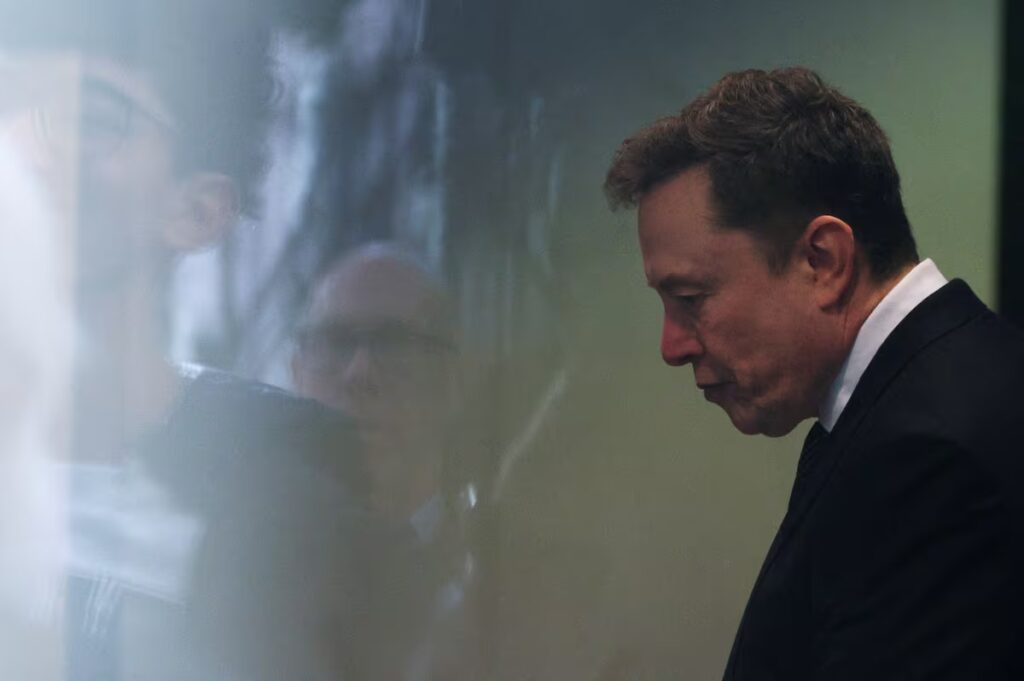
Elon Musk has taken the stand at the Oakland courthouse in California as part of his ongoing legal battle against OpenAI, the artificial intelligence company he co-founded with Sam Altman. Once allies, Musk now sees Altman as his primary adversary. On his first day of testimony, Musk expressed deep concerns about AI, stating it could be potentially lethal. His second day focused on elucidating his departure from OpenAI and responding to sometimes aggressive questioning from OpenAI’s lawyers. Notably, Altman was present in the courtroom, silently taking notes. Musk’s testimony will continue on Thursday.
Beginning his testimony at 8:30 AM and concluding around 2 PM, Musk addressed an audience packed with curious spectators and journalists. He remarked that OpenAI aims to “have the cake and eat it too,” suggesting it wants to balance profit motives with charitable intentions. This contradiction lies at the heart of Musk’s legal complaint, wherein he argues that he initially envisioned OpenAI as a non-profit to benefit humanity, but claims Altman has altered its structure for personal gain. Musk is seeking $150 billion (approximately €130 billion) in damages, which he states will be donated to charity, although he has not provided specifics. Altman and his team refute Musk’s claims, asserting he was aware of the structural changes and that this lawsuit is a strategic maneuver on Musk’s part.
During the proceedings, emails exchanged between Musk, Altman, and Greg Brockman, another co-founder and president of OpenAI, surfaced. Initially friendly but later contentious, these communications revealed Musk’s opposition to OpenAI becoming a for-profit entity. He maintained that he aimed to ensure the technology remained beneficial to humanity, viewing profit as a detrimental goal.
However, OpenAI’s attorneys presented Musk with additional emails suggesting he had aspirations to create a profitable enterprise under his control. They also referenced meetings involving Altman, Brockman, and Shivon Zilis, an influential figure at OpenAI and Musk’s associate. Musk appeared uncomfortable as they challenged his assertions, asserting that their claims were false. Under cross-examination by William Savitt, OpenAI’s lawyer, Musk’s demeanor shifted, becoming increasingly combative. “Your questions are not simple,” he retorted, turning to respond in monosyllables. The judge had to intervene to cool tensions in the courtroom.
“I was an idiot who provided them with free funding to create a start up.”
Elon Musk, in the OpenAI trial
Musk portrayed himself as somewhat naive, claiming he had been misled. “I was an idiot who provided them with free funding to create a start-up,” he asserted, referencing the $38 million he contributed, which he claims led to the $800 billion valuation of OpenAI today. He acknowledged that while he may have called someone from the company an “imbecile,” he did not lose his temper, stating, “Sometimes you have to use language that takes people out of their comfort zone.” He passionately declared, “Without me, OpenAI would not exist!” when pressed on his comparatively modest financial input compared to the company’s valuation.
The tension escalated as Savitt continued to press Musk, prompting him to withdraw some questions. Savitt also attempted to highlight Musk’s connection to former President Donald Trump, underlining Musk’s role as an advisor on AI-related issues. Musk had originally invested in OpenAI to create an alternative to Google that would benefit humanity but left in 2018, which he now regrets. He cited the need to save Tesla from bankruptcy as the reason for his departure.
Since Musk’s exit, OpenAI has gained significant traction and financial success, boasting an estimated value of around $840 billion and gearing up for a potential IPO. Musk contests that this was never the intended goal and filed a lawsuit against the organization and Microsoft, its primary partner, claiming undue influence and profit motivation. He noted that Microsoft invested approximately $10 billion in OpenAI, indicating that such an investment indicates high expected returns. After he declined Altman’s offer to rejoin OpenAI, Musk remarked that he had lost trust in him, considering it a “bribe.”
In his lawsuit, Musk has expressed concerns about the implications of transforming a non-profit organization into a private corporate entity, and the risks associated with concentrated technological power. However, Musk’s own interests in his AI company, xAI—which recently merged with SpaceX, now valued at $1.25 billion—could benefit from undermining OpenAI. Musk insists the essential issue is not his profit motivations but the organizational evolution that he believes is fraught with danger. Notably, OpenAI’s defense questions why Musk waited almost a decade to file his lawsuit if he was genuinely opposed to its transformation, suggesting ulterior motives, especially following Microsoft’s investment.
The jury selection occurred on Monday, and the trial commenced with opening statements just the day prior. Key witnesses, including Sam Altman, Microsoft CEO Satya Nadella, and others, are set to testify in the ongoing case. The hearing is expected to resume on Thursday, with Musk returning to the stand to face further inquiries.
Judging the proceedings is Yvonne Gonzalez Rogers, an experienced figure in tech-related litigation, who is striving to keep media attention to a minimum. Before the courtroom session on Wednesday, she reprimanded an attendee for taking photos, a prohibited action, and urged Musk to limit his social media activity amid the high-profile nature of the trial.