
You may have noticed a growing trend in athletic footwear featuring distinctive holes in the sole. This surge is attributed to the brand On, which has rapidly gained recognition worldwide, particularly since the pandemic. Previously a niche name in the sports industry, On has now transcended running culture, becoming a significant cultural sensation. Last week, the brand made headlines by announcing its partnership with Kylian Mbappé, the Real Madrid forward who recently ended a two-decade collaboration with Nike. On has also secured collaborations with luxury fashion house Loewe, superstar Zendaya, and tennis legend Roger Federer, who is so invested in the brand that he has become a shareholder.
The brand's meteoric rise is reflected in its financial performance. In 2019, On reported 267 million Swiss francs (approximately $325 million) in revenue. Fast forward to 2025, and projections suggest that this figure will soar to 3.014 billion Swiss francs (approximately $3.67 billion). In Spain, the interest in On's products is a recent phenomenon. According to JD Sports, “In 2023, we began to notice an increase in interest among our customers, and it was in 2024 that sales growth became truly remarkable.”
On's journey began with Swiss athlete Olivier Bernhard's innovative idea to create a new sole design by gluing pieces of hose together. Along with co-founders Caspar Coppetti and David Allemann, they produced the first trainers marked by their signature holes. Officially founded in 2010, On started with the founders as the initial users. “We began this company because we wanted a product that would enhance our running experience,” recalls Coppetti, who, along with Allemann, serves as CEO.
The company's headquarters in Zurich showcases some of these early shoe models and has recently opened its doors to the press for a closer look. The 17-story headquarters serves as a visual testament to On's growth. Initially occupying the lower floors, the company has quickly expanded, already claiming space up to the 15th floor. They anticipate needing more space soon, similar to a university campus where workshops create prototypes, including testing areas that analyze shoe performance.
Olivier Bernhard highlights that On's professional partnerships extend beyond traditional sponsorships. The company provides support in areas like nutrition, sleep, insurance, and taxes, alleviating daily stresses for athletes. This collaborative approach has allowed On to gather insights that shape their innovations. Jaime García Romo, head of product innovation, explains: “When runners visit us, they don't just request a shoe. They express desires for improved speed and less fatigue.” Such feedback drives the technical development process.
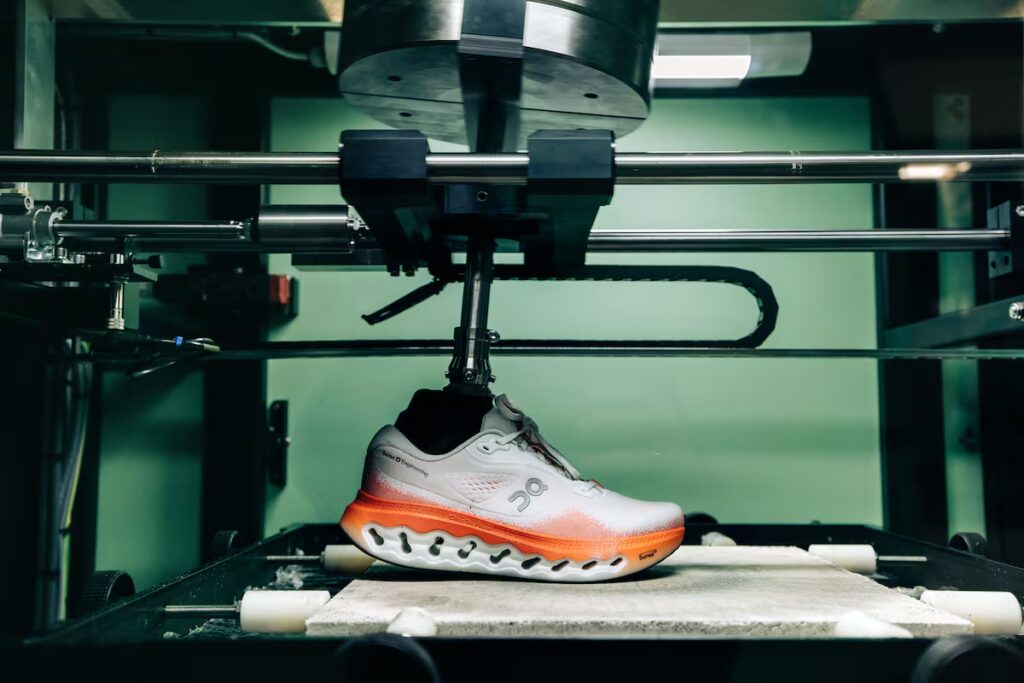
On employs advanced technology to determine optimal cushioning levels in their shoes. An overly hard sole can be uncomfortable, while one too soft can waste energy. To enhance performance, they iterate between designs based on athlete feedback. The LightSpray model, launched during the Paris Olympics, epitomizes their innovative approach. Made from a single 1,500-meter strand and produced in just three minutes, this shoe exemplifies lightweight and seamless design. Its manufacturing now occurs in both South Korea and Switzerland, effectively meeting demand.
On's extensive patent portfolio bolsters its technological advancements, with 200 patents registered last year. However, the brand's recent exponential growth can also be credited to a significant cultural shift toward experiential consumerism. “The rise of the movement generation reflects a change from ownership to experiences,” notes Allemann. “Sports have become central to this shift, emphasizing health and longevity as new forms of wealth.” Consequently, athletic gear has transitioned from mere functionality to a staple of personal identity.
While established brands like Nike and Adidas grapple with maintaining consumer interest without alienating more technical audiences, On adeptly merges performance with style. “We are not about choosing between performance or fashion; we aim to combine both while innovating,” explains Coppetti. The brand's appeal extends beyond high-performance athletes, particularly among women in their 30s and 40s, who appreciate On shoes for leisure activities. Gradually, younger male consumers are also becoming more interested.
“Every product must be exceptional,” says Bernhard, emphasizing On's commitment to quality and a culture that encourages all ideas. As the brand continues to evolve, it remains to be seen whether they can maintain this innovative spirit with each new development.



![Protest in [Location]: Cyclists Go Nude to Demand Safer Roads](https://instantvista.com/wp-content/smush-webp/2026/09/Protest-in-Location-Cyclists-Go-Nude-to-Demand-Safer-Roads-150x150.jpg.webp "Protest in [Location]: Cyclists Go Nude to Demand Safer Roads 5 - Instant Vista")