Stand in front of the Registan for the first time and the instinct is the same one that ruins most first hours in Samarkand: lift the phone, step back for the widest shot, and treat three centuries of Islamic architecture as a single blue wallpaper. Resist it. The square is not a backdrop; it is a civic stage that Timur’s grandson Ulugh Beg began in the fifteenth century and that later rulers completed, rebuilt and reimagined. The city around it is older still, layered with Sogdian ruins, Timurid tombs, a Soviet grid and a busy modern boulevard. This guide is how I would spend two or three days in Samarkand, in Uzbekistan, learning to read those layers instead of collecting them as tiles.
Samarkand sits on the Zeravshan valley, for centuries a hinge of the Silk Road between China, Persia and the Mediterranean. In 2001 UNESCO inscribed the historic city as “Samarkand – Crossroad of Cultures,” recognising the ensemble of monuments and the urban fabric that still ties them together. Give the place at least two full days. One day turns it into a checklist; two days let the blues separate into different workshops, centuries and intentions.
Orient Yourself: Three Cities in One
Before you chase turquoise domes, fix a mental map. Ancient Samarkand grew on the hill of Afrasiyab (Afrosiyob), northeast of the tourist centre, where archaeologists have traced a Sogdian city destroyed by the Mongols in the thirteenth century. Timur (Tamerlane) rebuilt his capital to the south and west of that ruin in the late fourteenth century, planting the Friday mosque, the royal necropolis and the madrasahs that still define the postcard. Soviet planners later laid a broad modern axis through the city, and today’s hotels, cafés and the Afrosiyob high-speed station sit in that contemporary layer.
That geography matters for walking. The Registan, Gur-e-Amir, Bibi-Khanym and Shah-i-Zinda form a compact historical core you can cover on foot if the heat allows, but they are not a single pedestrian mall. Distances stretch in summer sun, taxis are cheap, and pairing sights by neighbourhood saves energy: Registan with Gur-e-Amir; Bibi-Khanym with Siab (Siyob) bazaar; Shah-i-Zinda early, then the observatory or Afrasiyab museum if you still have legs. Treat the modern boulevard not as an intrusion but as the city’s working spine, the place where Samarkand eats dinner after the monuments close.
Read the Registan as Three Buildings, Not One Backdrop
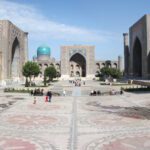
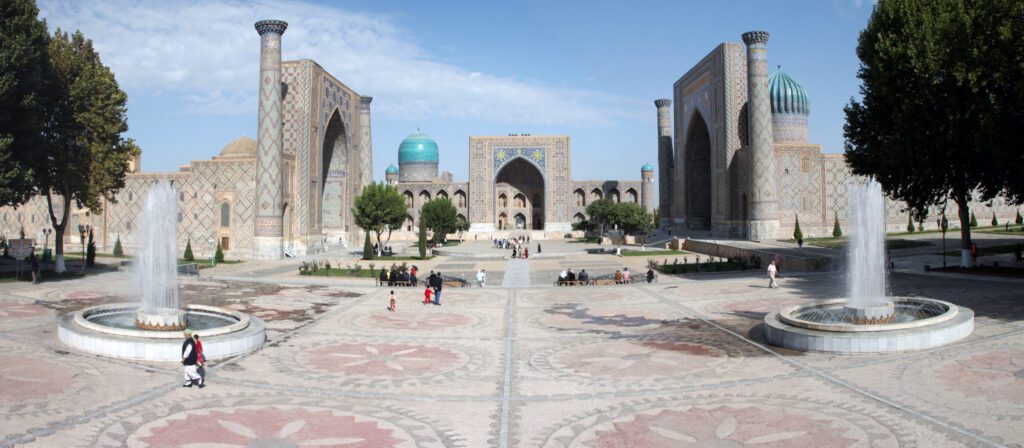
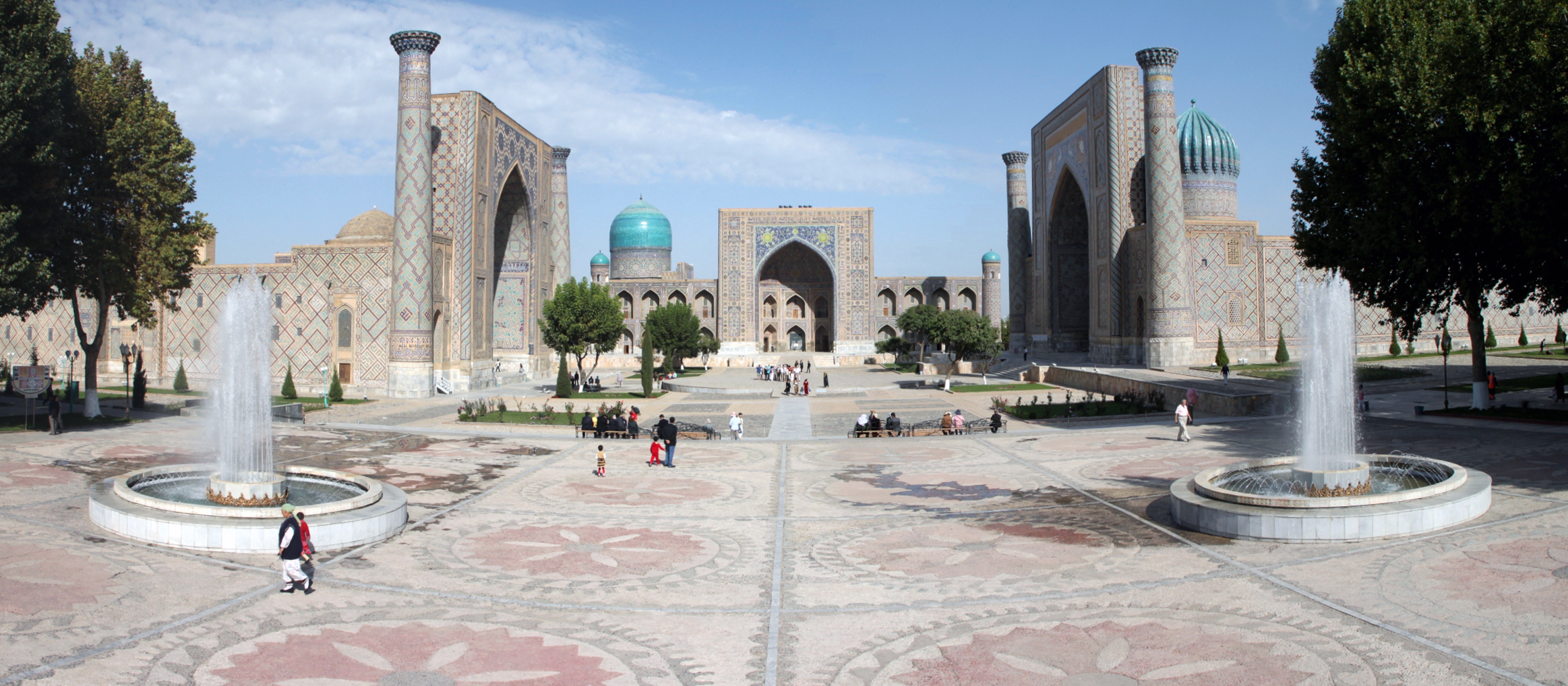
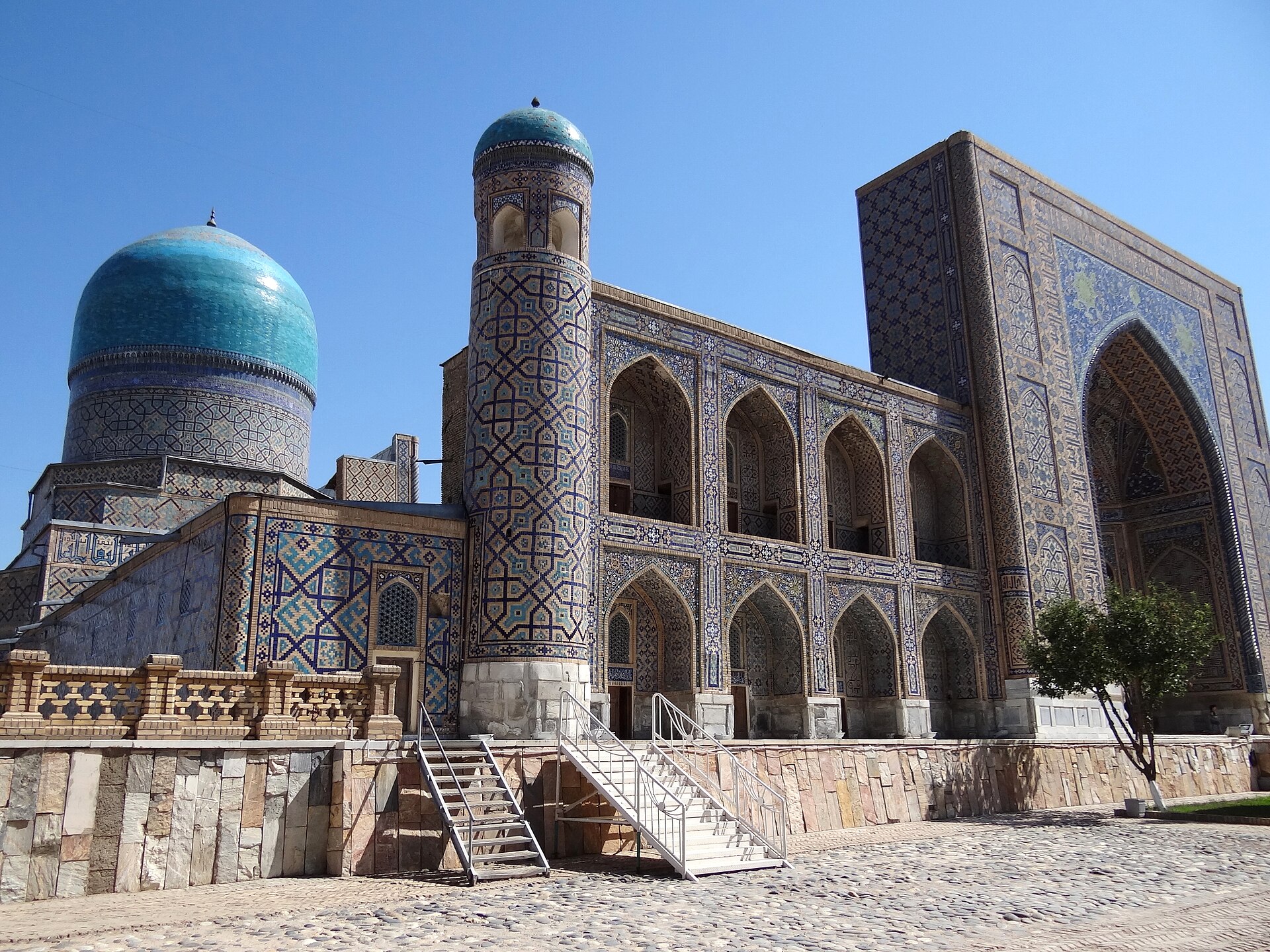
The Registan, from a Persian word roughly meaning “sandy place,” was the medieval public square: markets, proclamations, justice. What you see today is an ensemble finished across more than two centuries. Start with the oldest façade, the Ulugh Beg Madrasah on the west side, built between about 1417 and 1420 by Timur’s grandson, the astronomer-prince who also founded the observatory on the city’s edge. Its portal and corner minarets set the geometric grammar the later buildings would answer.
Facing it across the square is the Sher-Dor Madrasah, erected between 1619 and 1636 under the Shaybanid ruler Yalangtush Bahadur. Look up at the tympanum: two tiger-like beasts chase deer beneath a sun with a human face, a rare figurative flourish in a tradition that usually avoids living forms on religious façades. The northern side closes with the Tilya-Kori Madrasah, completed around 1660, whose name means “gilded.” Step into its prayer hall when it is open; the restored gold-leaf kundal work explains why this building later served as Samarkand’s main Friday mosque after Bibi-Khanym fell into ruin.
Go twice. Morning light picks out the tile patterns without the evening floodlights’ theatre; after dark the square becomes a civic living room again, and from spring through autumn there is often a sound-and-light programme. Buy tickets at the official booth or online when available, and budget ninety minutes to two hours if you want courtyards as well as façades. Most of all, walk the square slowly enough to notice that the three buildings disagree politely with one another: different centuries, different patrons, one shared civic idea.
Climb Shah-i-Zinda Before the Groups Arrive
If one place in Samarkand consistently outruns the Registan in intimate detail, it is Shah-i-Zinda, the “Living King.” The necropolis climbs a hillside above Afrasiyab as a narrow avenue of mausoleums, most of them fourteenth and fifteenth century, with older roots at the shrine of Qusam (Qutham) ibn Abbas, a cousin of the Prophet Muhammad traditionally said to be buried here. That shrine still draws pilgrims, which is why modest dress, quiet voices and restraint with the camera are not optional etiquette; they are the price of being a guest.
Arrive at opening. By mid-morning tour groups fill the lane shoulder to shoulder, and the blues turn into a corridor of phones. Walk to the top first, then descend slowly, reading façades as you go: Timurid ceramic work at its densest, colour shifting from turquoise to deep cobalt, geometric and vegetal patterns stacked like manuscripts in glazed tile. Family tombs of Timur’s relatives sit among the ensemble; the point is not to memorise every name but to feel how a dynasty staged piety and memory along a climb.
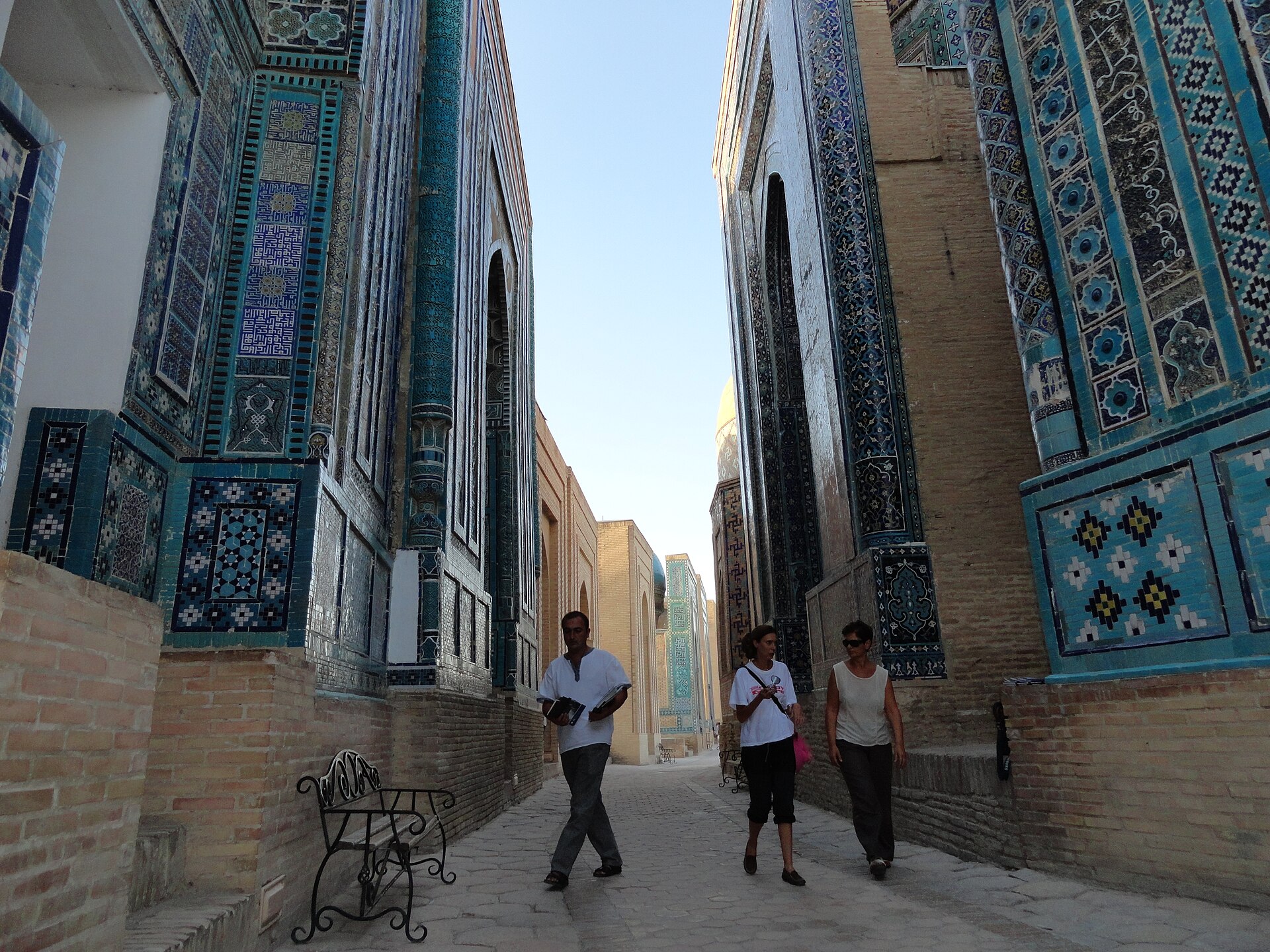
Allow an hour to ninety minutes. Shoulders and knees covered for everyone; a scarf for women is wise. Do not photograph people at prayer. Shah-i-Zinda rewards the visitor who treats it as a living cemetery and shrine first, a photo set second.
Bibi-Khanym, Siab Bazaar and the Smell of Fresh Non
From the Registan a pedestrian stretch leads toward Bibi-Khanym Mosque, Timur’s colossal Friday mosque begun after his Indian campaign around 1399 and largely completed by 1404–1405. In its day it ranked among the largest mosques in the Islamic world; the entrance portal still rises on a scale that photographs flatten. Ambition outran engineering. Earthquakes and structural failure left the complex in ruins for centuries, and much of what stands now is a heavy Soviet-era reconstruction. That history is part of the visit: admire the massing and the surviving tile, note the huge marble Quran stand in the courtyard, and be honest that the interior is quieter than the legend.
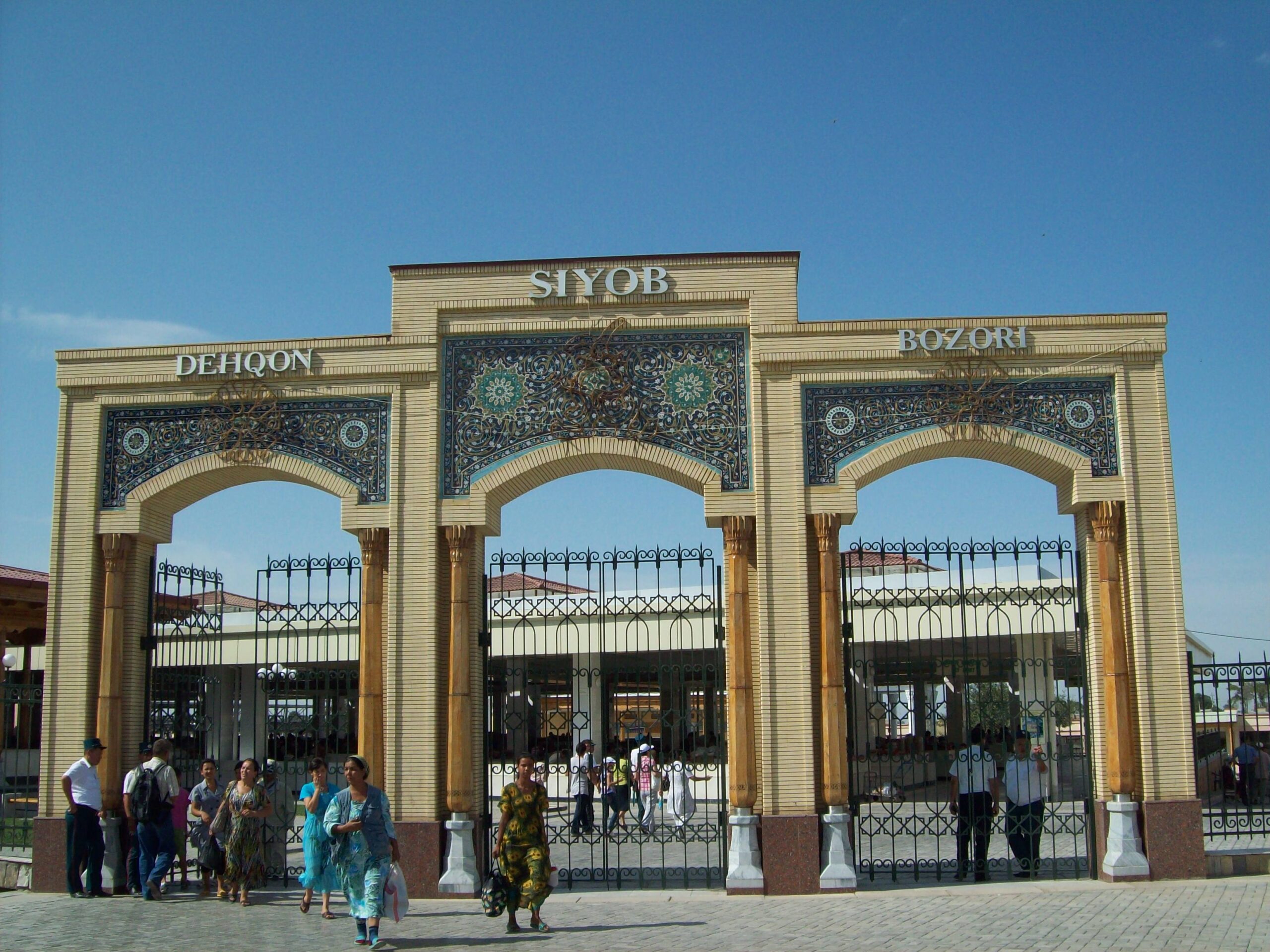
Step out toward Siab (also spelled Siyob or Siyab) bazaar, Samarkand’s main market, which sits beside the mosque and costs nothing but attention. This is where the Timurid city still feeds itself: pyramids of dried apricots and walnuts, spices, sweets, pomegranates in season, and the dense round Samarkand non that bakers pull from the tandir in the morning. Come hungry, carry cash in som, ask before you photograph traders, and haggle gently if you buy. A train picnic assembled here beats another restaurant lunch, and the bazaar is the simplest reminder that Samarkand is not a museum campus.
Gur-e-Amir, Ulugh Beg and the Edge of the Old Story
South of the Registan, Gur-e-Amir holds Timur’s tomb beneath a fluted turquoise dome that has become almost as emblematic as the square itself. The mausoleum is smaller than the legends that surround it; go for the interior stone and the sense of dynasty compressed into one chamber, including the graves of Timur, his sons and his grandson Ulugh Beg. It pairs naturally with a Registan morning: civic power in the square, dynastic memory a short walk away.
If you have a second afternoon, leave the postcard axis. Ulugh Beg’s observatory, built around 1420 on a hill northeast of the centre, survives mainly as the excavated lower arc of a huge meridian sextant set in the earth, with a small museum above. It is a quiet corrective to the tile overload: proof that Timurid Samarkand measured the sky as carefully as it dressed its portals. Nearby, the Afrasiyab Museum interprets the painted Sogdian murals and the pre-Timurid city under the grass. Neither stop is mandatory on a short visit; both deepen the place if you refuse to let Samarkand equal only three façades.
Practical Samarkand: Trains, Visas and When to Go
Getting there: Most international visitors fly into Tashkent and continue to Samarkand on the Afrosiyob high-speed train, which covers the roughly 300 kilometres in about two hours. Book early on the official Uzbekistan Railways site, eticket.railway.uz, or the railway app; sales typically open around 45 to 60 days ahead, passport details are required, and popular morning trains in April–May and September–October sell out. There is also Samarkand International Airport with a growing list of direct flights, useful if you want to skip the capital leg.
Visas: Uzbekistan runs a broad visa-free regime for citizens of many countries, typically for stays of up to 30 days, and an e-visa portal at e-visa.gov.uz for nationalities that still need prior authorisation. Rules change; check the official foreign-affairs or e-visa site for your passport before you book. Hotels usually handle the mandatory registration of stay.
When to go: Spring and autumn are the kindest seasons for long walks between monuments. Summer on the valley floor is fiercely hot by midday, so shift Shah-i-Zinda and the Registan courtyards to early morning. Winter is quieter and colder, with shorter opening hours at some sites. Entry fees for the main ensembles are modest by European standards but add up; carry som and a card for hotels and larger restaurants.
How to move: Walk the core, use Yandex Go or street taxis for hops, and sleep within walking distance of the Registan if night views matter to you. Dress for active mosques and shrines: covered shoulders and knees, and a scarf for women at Shah-i-Zinda and prayer spaces.
Samarkand is the place where Central Asia’s imperial architecture and its market city still share the same streets. Give it time, separate the three madrasahs in your mind, climb the necropolis before the buses, and leave room for bread still warm from the tandir. The tiles will photograph themselves; the city only appears when you stop treating it as a set.
Featured image: Registan Square and its three madrasahs. Photo: Stomac / Wikimedia Commons, CC BY-SA 2.0 FR