The first time I walked into Fès el-Bali I made the classic mistake: I tried to follow a map. Within ten minutes the blue dot on my phone was spinning, the lane I was in had narrowed to the width of my shoulders, and a man leading a donkey loaded with gas bottles was politely asking me to flatten myself against a wall. That is the moment Fez starts to make sense. The old city of Fez is not a monument you look at; it is a living city of workshops, mosques, schools and homes that you move through on foot, and it rewards people who learn its logic rather than fight it. Here is how I would spend a few days in Morocco’s great medieval capital without turning it into a race between photo stops.
Understand the Three Cities Before You Enter One
Fez is really three cities. Fès el-Bali, “Old Fezâ€, is the walled medieval core in the valley of the Oued Fes. Fès el-Jdid, “New Fezâ€, is the royal city the Marinids added next to it in 1276. The Ville Nouvelle, laid out under the French protectorate in the twentieth century, is where you will find the train station, the wide avenues and most of the modern hotels.
The story begins in the Idrisid period. In 789 Idris I founded a town on the right bank of the river, and in 809 his son Idris II founded a second settlement on the opposite bank. For two centuries they grew as separate towns, one populated largely by refugees from Córdoba in al-Andalus and the other by families from Kairouan in today’s Tunisia, until the Almoravids enclosed them within a single wall in the eleventh century. The city reached its golden age under the Marinids in the thirteenth and fourteenth centuries, when it replaced Marrakesh as the capital of the kingdom, and most of the madrasas, fondouks and fountains you will admire date from that era.
In 1981 UNESCO inscribed Fès el-Bali and Fès el-Jdid together on the World Heritage List as the Medina of Fez, a property of 280 hectares that UNESCO describes as one of the most extensive and best conserved historic towns of the Arab-Muslim world. Even though the political capital moved to Rabat in 1912, Fez kept its role as the country’s cultural and spiritual centre, and you feel that weight in the call to prayer rolling across the rooftops at dusk.
Enter Through Bab Bou Jeloud and Let the Medina Lead
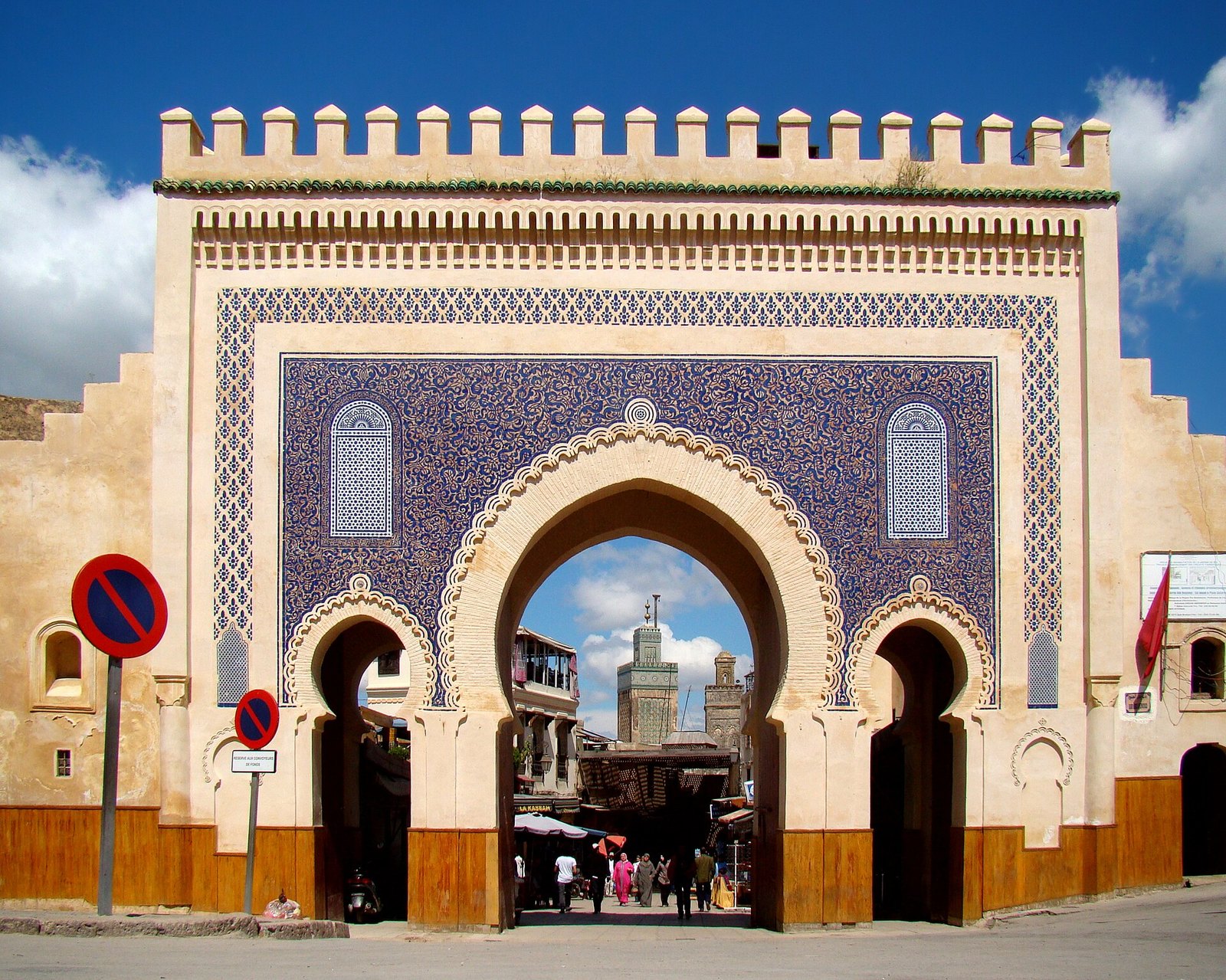
Most visitors enter the medina through Bab Bou Jeloud, the triple-arched “Blue Gate†on its western edge. It looks ancient, but the monumental gate was built by the French colonial administration in 1913 to give the old city a grand entrance; the original, much humbler gate is still visible, walled up, to its left. The outer face is clad in blue tiles, the inner face in green, and through the central arch you can frame the minarets of the Bou Inania Madrasa and the Sidi Lazzaz Mosque.
Beyond the gate, two main streets fan out downhill: Tala’a Kebira and Tala’a Seghira. Both eventually bring you to the heart of the medina around the Qarawiyyin, and that is the single most useful fact for a first-time visitor. The city tilts towards the river, so if you are lost, walking downhill usually takes you towards the centre and walking uphill takes you back towards the gates. The gate also marks the point beyond which cars generally cannot go. Inside, deliveries still travel by handcart, mule and donkey, and when you hear “balakâ€, it means “watch outâ€: step aside, quickly.
Getting lost is part of the experience, but it helps to do it deliberately. Spend your first morning with a licensed guide, booked through your riad or the tourist office, simply to learn the main arteries and landmarks. After that, wander alone. Young men will offer to show you the way, sometimes insistently; a firm, friendly “no, thank you†works, and if you do accept help, agree on a price first.
Madrasas, Water Clocks and the Qarawiyyin
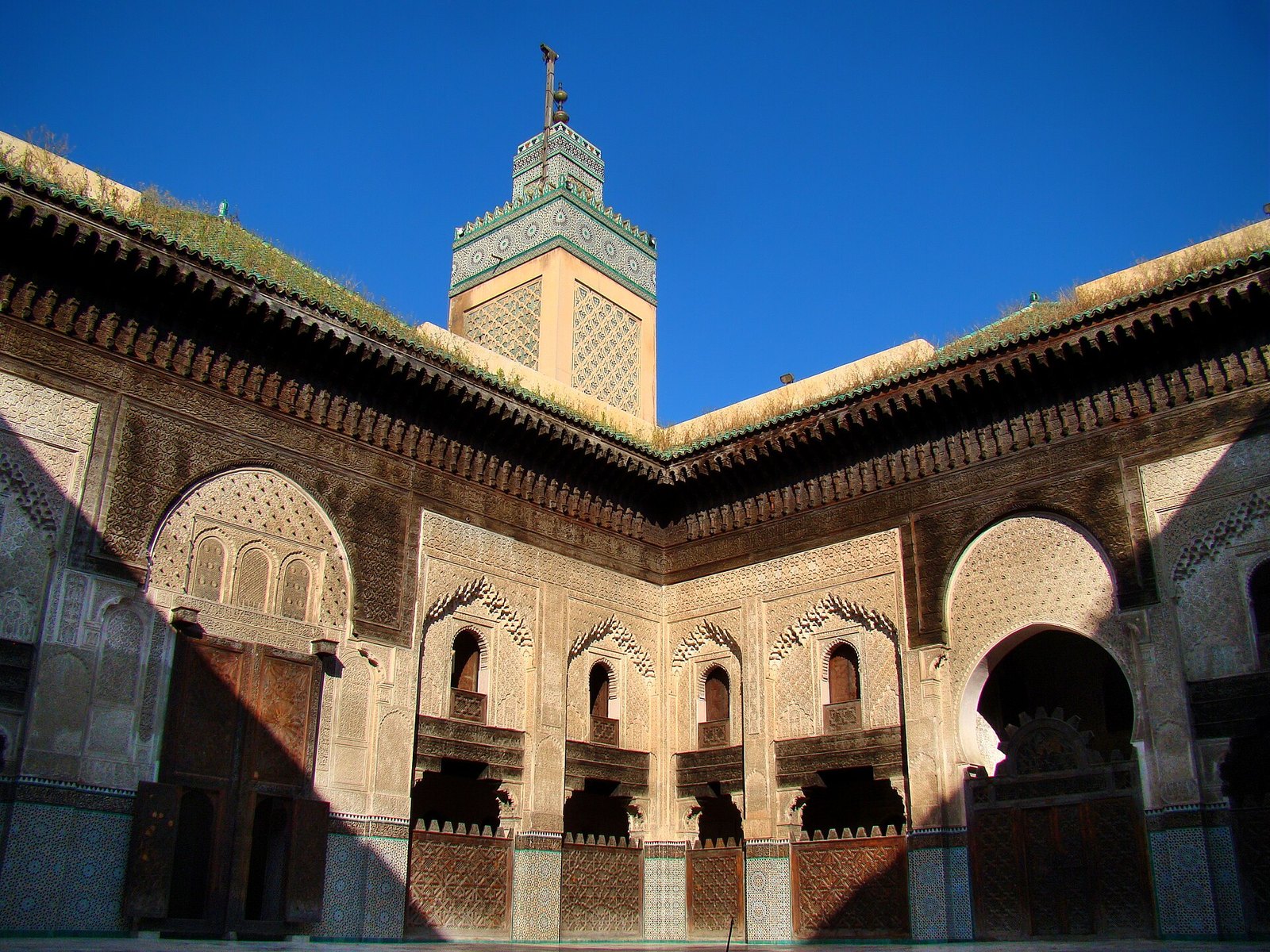
A few minutes down Tala’a Kebira is the Bou Inania Madrasa, built between 1350 and 1355 by the Marinid sultan Abu Inan Faris. It is the only madrasa in Morocco that also functioned as a congregational mosque, which is why it has a tall minaret, and it is widely considered a high point of Marinid architecture. It is also one of the few religious buildings in Fez that non-Muslim visitors can enter. Stand in the marble courtyard and read the walls from bottom to top: zellij tilework at eye level, carved stucco above it, then carved cedar beneath the eaves. Across the street, look up at the façade of the Dar al-Magana, a water clock reportedly completed for Abu Inan in 1357: thirteen carved wooden consoles once held bronze bowls that rang the hours, though the mechanism that drove them has disappeared.
Keep descending and you reach the spiritual core of the city, the al-Qarawiyyin Mosque. According to tradition it was founded in 859 by Fatima al-Fihri, the educated daughter of a wealthy merchant whose family had come from Kairouan; some modern historians question parts of that story, but UNESCO and Guinness World Records cite al-Qarawiyyin as the oldest continuously operating institution of higher learning in the world. The mosque is closed to non-Muslims, so respect that and glimpse the courtyard from the open doors without lingering in the way of worshippers. Its library, founded by Abu Inan in 1349, holds treasures such as a copy of Ibn Khaldun’s history, including the Muqaddimah, that the author himself gave in 1396. The library building has since been restored by the Moroccan architect Aziza Chaouni.
Next door, the smaller Al-Attarine Madrasa, built between 1323 and 1325 and named after the spice and perfume market around it, is in my view the most perfectly proportioned building in the city. Then step out into Place Seffarine, the coppersmiths’ square, and listen: the hammering has not stopped for centuries.
The Chouara Tannery: Look, Smell, Then Look Again
Follow your nose, literally, east towards the river and you will reach the Chouara Tannery, the largest and one of the oldest of the city’s three tanneries, close to the Saffarin Madrasa. Local tradition dates the tanneries to the city’s foundation, though historians note that the earliest history of Chouara itself is not firmly established. What is certain is that the work has barely changed in centuries. Hides of cow, sheep, goat and camel are first soaked in white vats of quicklime, salt, water and pigeon droppings to soften them, then dyed in the honeycomb of stone basins with colourants that traditionally include poppy, indigo and henna, before being dried in the sun on surrounding roofs.
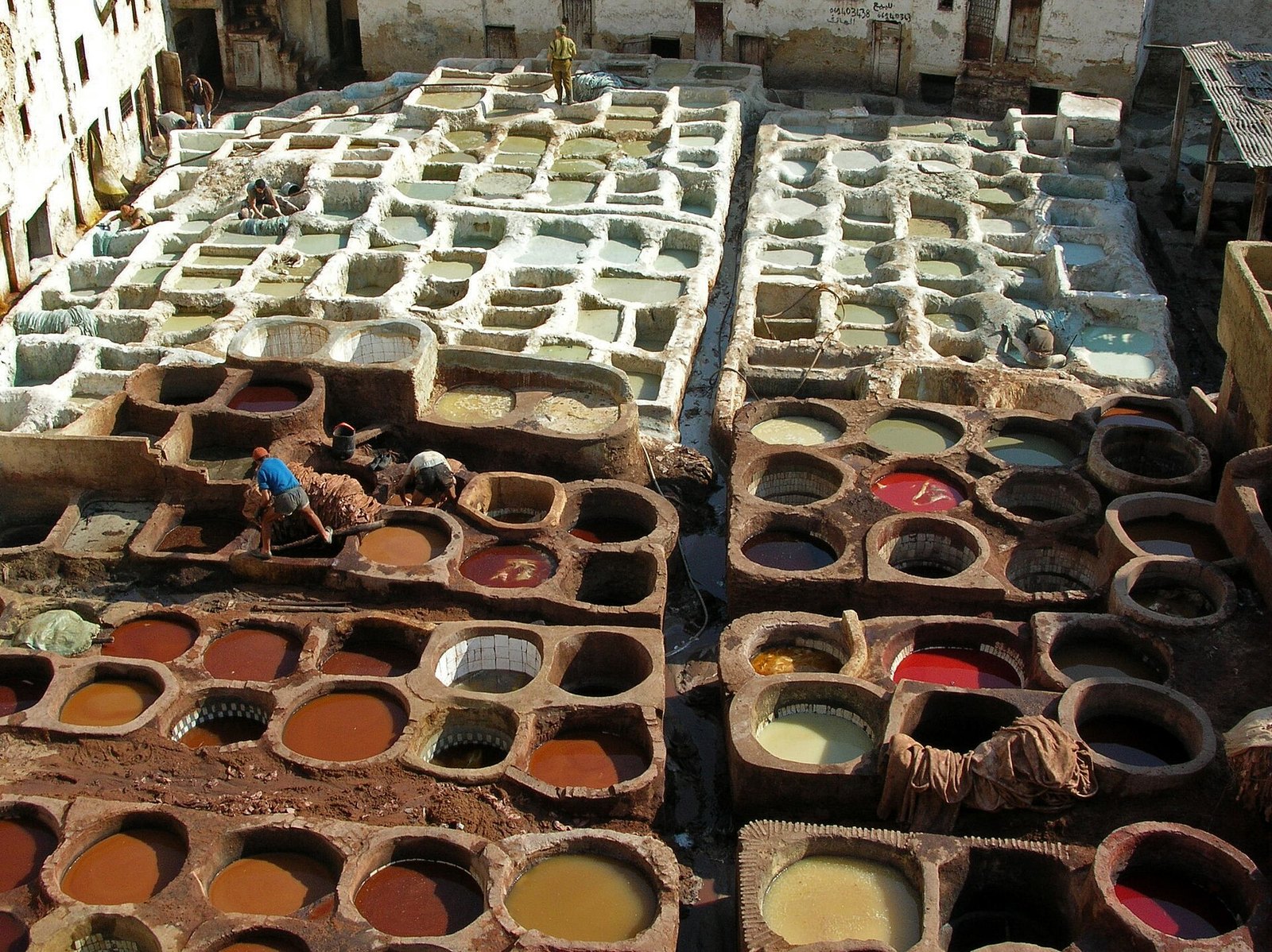
You view the vats from the terraces of the leather shops that surround them. Someone will hand you a sprig of mint to hold under your nose, and the shop owner will expect you to look at bags and slippers on the way out. Treat that as the price of the view: browse politely, buy only if you want to, and tip the person who guided you upstairs. Go in the morning, when the vats are at their most colourful and the work is in full swing. And remember that this is hard, physically punishing labour; the men below are workers, not performers, so keep your camera respectful.
Fès el-Jdid, the Mellah and the View from the Merinid Tombs
Give a second day to the royal city. Fès el-Jdid was founded in 1276 by the Marinid sultan Abu Yusuf Ya’qub as a fortified seat of government, and much of it is still occupied by the Royal Palace, the Dar al-Makhzen. You cannot go inside, but the monumental gates on Place des Alaouites, created when King Hassan II ordered a new entrance in the late 1960s and early 1970s, are among the most photographed doors in the country.
Beside the palace lies the Mellah, the historic Jewish quarter, believed to date from the mid-fifteenth century and the first district in Morocco to carry that name. Fez had one of the largest and oldest Jewish communities in the country; in the late 1940s an estimated 15,150 Jewish residents lived in the Mellah alone, but almost all later moved to Casablanca, France, Canada or Israel. Look for the houses with outward-facing wooden balconies, so different from the inward-looking homes of Fès el-Bali, visit the Ibn Danan Synagogue, believed to date from the late seventeenth century, and walk through the whitewashed Jewish cemetery at the quarter’s south-eastern corner.
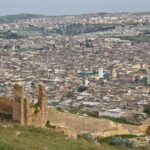
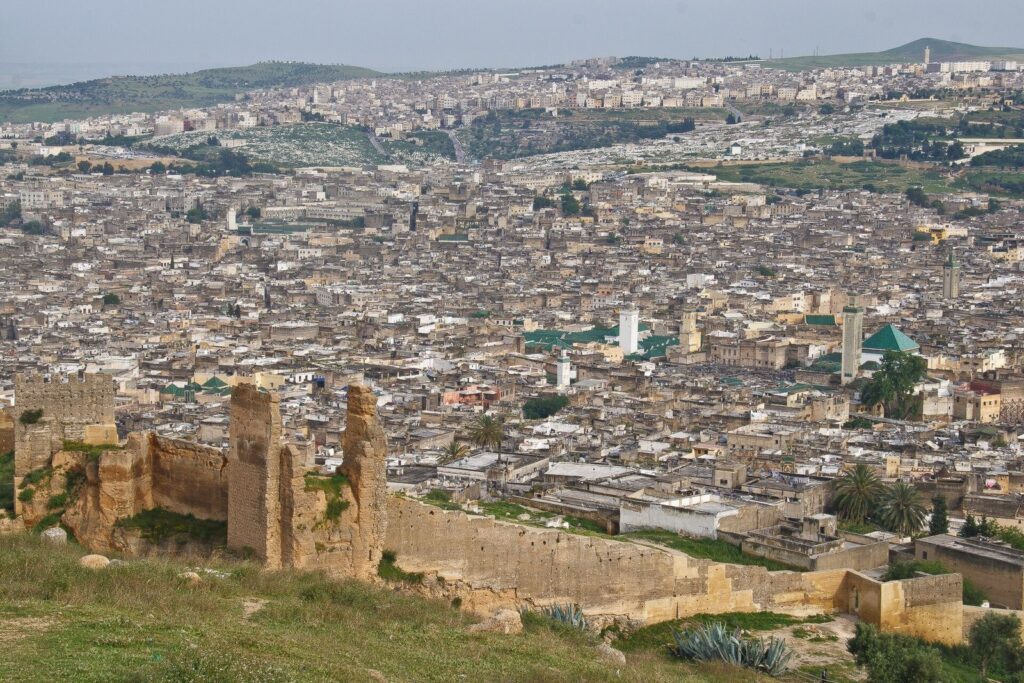
End the day on the hill north of the old city at the Merinid Tombs, a cluster of ruined fourteenth-century royal tombs that has become the best viewpoint over Fès el-Bali. Arrive an hour before sunset, ideally by petit taxi and with company rather than alone, and watch the city turn gold, then grey, as the minarets light up and the evening call to prayer rises from hundreds of mosques at once. It is the view in the photograph at the top of this page, and it is the moment the medina finally fits into your head as a whole.
Practical Fez: Trains, Riads and When to Go
Getting there: Fez is well connected by rail through ONCF, the national railway. From Casablanca and Rabat, conventional trains run directly to Fez. From Tangier, the fastest option is the Al Boraq high-speed train, Africa’s first, to Kenitra, where you change to a conventional train; ONCF sells the two legs as one ticket, and the whole journey takes roughly three and a half hours. Timetables have shifted during construction of the Kenitra–Marrakech high-speed line, so check the ONCF app before you travel. Fez station is in the Ville Nouvelle, a short petit taxi ride from the medina gates.
Where to stay: Sleep inside the walls, in a riad or a dar, a traditional courtyard house converted into a guesthouse. Waking to the sound of the medina is half the experience. Because cars cannot reach most riads, ask yours to send someone to meet you at the nearest gate, especially if you arrive after dark; the lanes are confusing enough by daylight.
When to go: Spring and autumn are the sweet spots, with mild days for long walks. Summer in the valley can be fiercely hot, and winter nights are colder than many visitors expect, so pack a warm layer for unheated riad rooms. During Ramadan the rhythm of the city changes completely: quieter days, lively evenings and reduced opening hours for some shops and restaurants.
Etiquette: Dress modestly, cover shoulders and knees, ask before photographing people, and carry small change for tips and mint tea. Haggling is expected in the souks, but keep it good-humoured.
Fez is the place where North Africa’s medieval urban life never quite stopped. Give it at least two full days, get lost on purpose, and let the city, not the map, decide where you end up.
Featured image: Fès el-Bali seen from the hill of the Merinid Tombs. Photo: Mike Prince / Wikimedia Commons, CC BY 2.0