
The first time I arrived in Oaxaca at the end of October, the taxi from the airport could not get within three blocks of my guesthouse. A brass band was coming down the street, followed by a crowd in skull face paint, a man carrying a papier-mâché skeleton bride on a pole, and a grandmother handing out mezcal in tiny clay cups. I paid the driver, shouldered my bag and walked in behind them. That is the right way to enter Oaxaca during the Day of the Dead: on foot, a little late, and as a guest. The city in southern Mexico has become one of the most photographed places on earth in the first days of November, but behind the face paint is something quieter and far more interesting. Here is how I would spend a week there without reducing it to a backdrop.
Understand Why the Valley Matters Before You Arrive
Oaxaca de Juárez, the state capital, sits at roughly 1,550 metres in a broad highland valley where three arms of the Central Valleys meet. Long before the Spanish laid out its grid in the 1520s and 1530s, this was the heartland of the Zapotec civilisation, and later of the Mixtecs who moved into the valley. Today the state of Oaxaca is one of the most linguistically diverse in Mexico, home to more than a dozen Indigenous peoples, and you will hear Zapotec spoken in the markets as easily as Spanish.
In 1987 UNESCO inscribed the Historic Centre of Oaxaca and the Archaeological Site of Monte Albán together on the World Heritage List. The pairing is the key to reading the place. On the mountain above town is a ceremonial city that was the Zapotec capital for well over a thousand years; in the valley below is a colonial city built from the same pale green volcanic stone that gives its churches their soft, almost mossy colour. The Day of the Dead traditions that draw the crowds are a living bridge between the two, which is why UNESCO also recognises Mexico’s Indigenous festivity dedicated to the dead as Intangible Cultural Heritage.
Walk the Historic Centre From the Zócalo to Santo Domingo
Start in the Zócalo, the main square, shaded by laurel trees and ringed by café terraces under arcades. The cathedral stands on its north side, and in the evening the square fills with balloon sellers, marimba players and families who have come in from the villages. It is the best people-watching seat in town, and the place to get your bearings before the streets get busy.
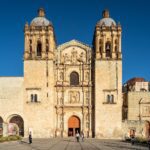
From the cathedral, walk north up Calle Macedonio Alcalá, the pedestrian street locals simply call Alcalá. It is lined with restored colonial houses, galleries, mezcal bars and small museums, and it climbs gently for about six blocks to the city’s showpiece, the Church and former Convent of Santo Domingo de Guzmán. The Dominicans began building it in the late sixteenth century, and the restrained stone façade gives little warning of the interior: a riot of gilded stucco, carved saints and a family tree of the order’s founder climbing across the vault, with the even more lavish Rosary Chapel to one side.

The old convent next door now houses the Museo de las Culturas de Oaxaca, and it deserves at least two hours. Its most famous room displays the treasure of Tomb 7 at Monte Albán, excavated by the archaeologist Alfonso Caso in 1932: gold, rock crystal, jade and carved bone left by Mixtec nobles who reused a Zapotec tomb. Behind the complex lies the Jardín Etnobotánico, a garden of cacti, agaves and native plants that can only be visited on a guided tour, so check the schedule at the gate.
Climb Monte Albán Early, Before the Sun and the Coaches
Monte Albán sits on a mountaintop that the Zapotecs levelled around 500 BC, roughly 400 metres above the valley floor and about ten kilometres from the centre. Shuttle buses leave from the city in the morning, and a taxi takes around twenty minutes. Go at opening time: the light is better, the air is cool, and you will have the Great Plaza almost to yourself for the first hour.
The site is laid out along a north–south axis, with the vast plaza framed by platforms, temples and a ball court. Look for the Danzantes, a gallery of carved stone slabs showing contorted human figures that are among the oldest monuments on the site; scholars now tend to read them as captives or sacrificed enemies rather than dancers. Climb the North Platform for the classic view back across the plaza and out over the three valleys, which explains better than any museum label why rulers chose this ridge. Bring water, a hat and sunscreen, because there is almost no shade.

Experience Día de Muertos as a Guest, Not a Spectator
The Day of the Dead is not Mexican Halloween. In Oaxaca it is a family reunion with the people who have died, and the core of it happens at home. From the last days of October, families build an ofrenda, an altar decorated with orange cempasúchil marigolds, candles, copal incense, photographs, salt, water, and the favourite food and drink of the departed. The marigolds’ colour and scent are believed to guide the souls home. Traditionally the spirits of children are welcomed first, around October 31 and November 1, and adults on November 1 and 2.
For a visitor, the markets are the easiest way in. In the days before, the Mercado de Abastos and the city-centre markets overflow with marigolds, sugar skulls, candles and pan de muerto, the sweet egg bread decorated with a painted face. Buy something for your hosts if you are invited into a home; it is the polite thing to do.

At night the action moves to the cemeteries. Families clean and decorate the graves, then sit with their dead for hours, sharing food, music and mezcal. The best-known vigils are at the Panteón General in the city and in the nearby municipality of Santa Cruz Xoxocotlán, where the old and new cemeteries glow with thousands of candles. These are real graves and real families. Go quietly, ask before you photograph anyone, never use a flash, do not step on graves, and if a family offers you a drink or a seat, accept graciously and stay a while. In the streets you will also meet the comparsas, costumed processions with bands that weave through neighbourhoods and villages; joining at the back is usually welcome, standing in the way with a phone is not.
Eat Your Way Through Seven Moles, Two Markets and a Lot of Mezcal
Oaxaca is often called the land of seven moles, and while every cook will argue about which seven, the complex, chocolate-dark mole negro is the one to try first. Order it with chicken at a traditional fonda, then work through the coloradito, amarillo and verde over the following days. Other essentials are the tlayuda, a large, crisp tortilla spread with asiento (unrefined pork lard), beans, quesillo cheese and grilled meat, and chapulines, toasted grasshoppers seasoned with lime and chilli, which taste far better than they sound.

For lunch, head to the Mercado 20 de Noviembre and find the pasillo de humo, the “smoke corridor”, where you choose raw tasajo (thin-cut beef), cecina and chorizo from a butcher, hand it to a grill master, and eat it with tortillas, onions and salsas at shared tables. Next door, the Mercado Benito Juárez sells chocolate, chillies, cheese and crafts. Finish with a cup of hot chocolate made with water or milk, ground with cinnamon and sugar, and a piece of sweet bread to dip in it.
Then there is mezcal. The state produces most of Mexico’s mezcal, distilled from agave hearts roasted in earthen pits. Rather than ordering the cheapest pour in a bar on Alcalá, find a tasting room that lists the agave species, village and producer for each bottle, and sip slowly. A day trip to the distilleries around Santiago Matatlán, on the road to Mitla, shows you the whole process, from the pit to the copper or clay still.
Practical Tips: Booking, Day Trips and Staying Past November 2
Book early, or come later. Accommodation for the last week of October and the first days of November fills months ahead, and prices rise accordingly. If you can be flexible, the second half of November is calmer, cheaper and still pleasantly dry and warm by day; the ofrendas linger in many homes and businesses for a while.
Getting there: Oaxaca’s international airport has direct flights from Mexico City, several other Mexican cities and a handful of US hubs. Comfortable first-class buses also link the city with Mexico City in about six to seven hours. Once you are there, the centre is compact and best explored on foot; nights at this altitude can be cool, so pack a warm layer.
Day trips: Combine the Zapotec site of Mitla, famous for its geometric stone mosaics, with the giant cypress known as the Árbol del Tule in Santa María del Tule, the weaving village of Teotitlán del Valle and the petrified mineral “waterfalls” of Hierve el Agua. Two separate days are better than one rushed loop. Go with a licensed local guide or a driver from a reputable agency, and spend your money directly with weavers and producers.
Respect the calendar: If you cannot make the Day of the Dead, consider July, when the Guelaguetza festival brings dance delegations from across the state to the city. Any time of year, dress for churches, tip generously, and learn a few words of Spanish; people notice.
Oaxaca is one of the great cities of Latin America precisely because it has not turned its traditions into a show. Arrive as a guest, follow the marigolds, and give the valley more than a long weekend.
Images: Wikimedia Commons, credited in each caption. Photos are used under their Creative Commons licences.