Most visitors meet Tbilisi through two images: carved wooden balconies leaning over a lane, and a row of brick domes steaming gently above the sulphur baths. Both are real, and both are worth your time. But the old town of the capital of Georgia is not a postcard set. It is a river city built on hot springs, fought over by Persians, Arabs, Byzantines, Mongols, Ottomans and Russians, and still lived in by people who hang their washing over the same courtyards you photograph. In this Travel guide I want to show you how to read Kala, Abanotubani and Sololaki as one layered place, the historic heart of a city that has been looking both ways across the Caucasus for fifteen centuries.
The quarters this guide covers lie close together on the right bank of the Mtkvari (Kura) River, under the ridge crowned by Narikala. You can cross the whole Old Town on foot in under half an hour, which is precisely why so many people rush it. Give it two or three unhurried days instead, including at least one early morning and one late evening.
Orient Yourself: A City Born From Warm Water
Start with the name. Tbilisi comes from the Georgian word tbili, meaning warm, and the founding legend explains why. King Vakhtang I Gorgasali of Iberia, so the story goes, was hunting in the forested valley when his falcon fell into a hot spring. The discovery of the springs led him to found a new city here in the fifth century, and his successors made it the capital. Whether or not the falcon ever existed, the geology is not in doubt: the sulphur springs still rise at the foot of the fortress hill, and the city has grown outward from them ever since.
Fix three reference points. Narikala, the fortress, runs along the ridge to the south. The river curves below it, with the cliff of Metekhi and its church on the opposite bank. Between them, in the narrow gorge where the springs emerge, sits Abanotubani, literally the bath district. Kala, the old walled core, spreads north from there towards Sioni Cathedral and the Gabriadze theatre, while Sololaki climbs west up the slope towards Mount Mtatsminda. Once you have that triangle in your head, getting lost becomes a pleasure rather than a problem.
Narikala and the Ridge: Reading the City From Above
Go up first, and preferably early. The quickest way is the cable car from Rike Park, on the left bank, which opened in 2012 and lifts you over the river and the rooftops in a couple of minutes. It is part of the municipal transport network, so you pay with a Metromoney card rather than cash at the turnstile. Alternatively, walk up from the baths or climb the stepped lanes of Betlemi, which is slower but shows you the courtyards from behind.
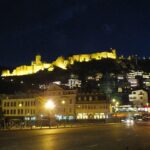
Narikala itself is a palimpsest. A fortress stood here by the second half of the fourth century; it was expanded under the Umayyads in the seventh century and again under King David the Builder, and the Mongols gave it the name Narin Qala, the little fortress. Most of the walls you see today date from the sixteenth and seventeenth centuries, and parts were damaged in an earthquake in 1827. Inside the lower court, the Church of St Nicholas is a 1990s rebuilding of a medieval church lost to fire, its interior painted with scenes from the Bible and Georgian history.
Follow the ridge west and you reach Kartlis Deda, the Mother of Georgia, a twenty-metre aluminium figure by the sculptor Elguja Amashukeli erected in 1958 for the city’s 1500th anniversary. She holds a bowl of wine in one hand for friends and a sword in the other for enemies, which is as concise a summary of Georgian hospitality as you will find. From here the whole city opens up: the domes of the baths, the river, Metekhi on its cliff and the modern districts climbing the hills beyond.
Abanotubani: How to Take the Sulphur Baths Seriously
Come down from the fortress into Abanotubani and you will smell it before you see it: the faint, eggy note of sulphur in the air. The springs are naturally warm, and by the end of the thirteenth century, chronicles record, Tbilisi had dozens of bathhouses. Today most of the historic baths sit partly underground, which is why from street level you see mainly low brick domes with small skylights, rather than buildings. The most photographed exception is the Orbeliani bath, often called the Blue Bath, whose tiled facade with a pointed arch looks as if it had been carried here from Isfahan.
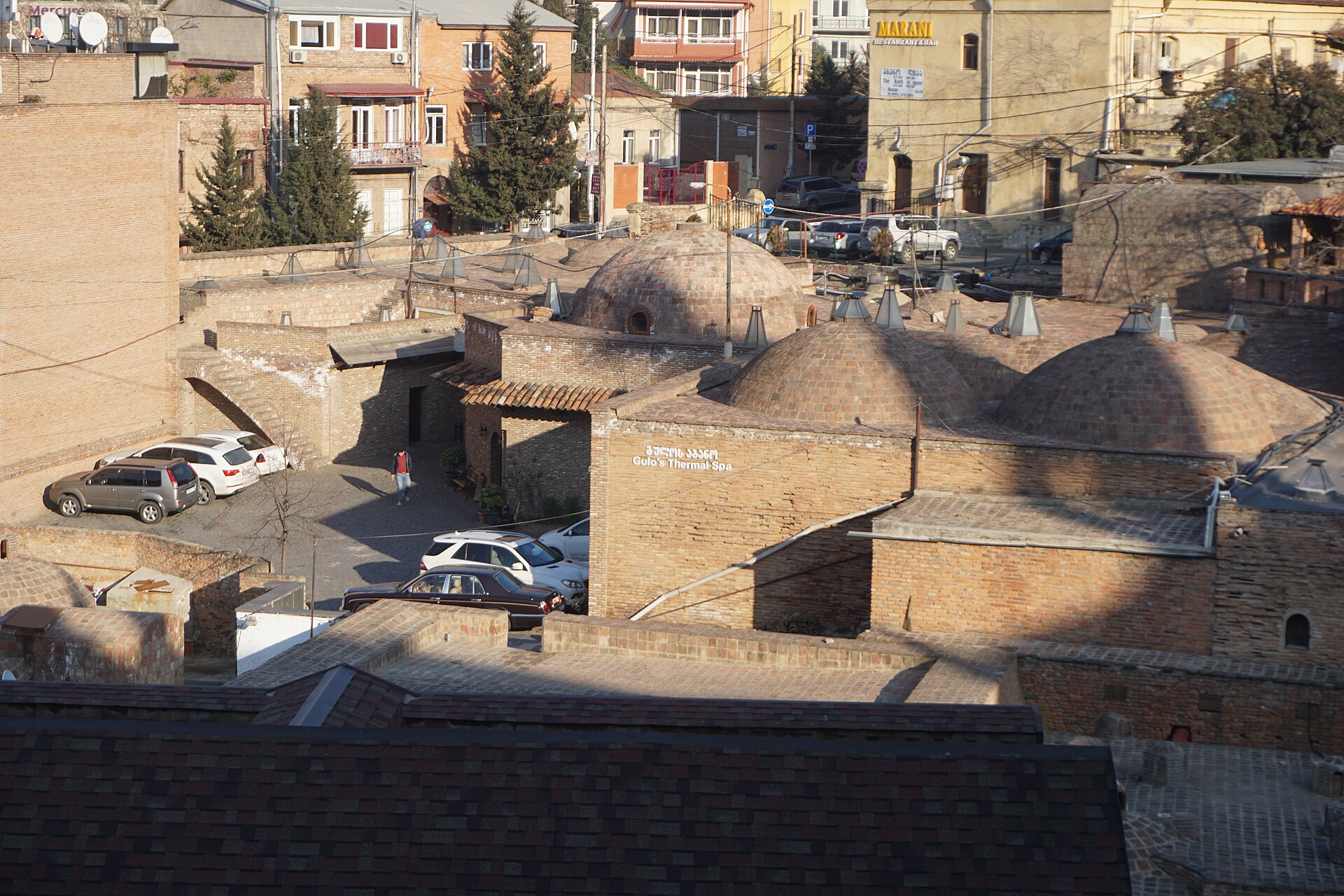
To use the Sulphur Baths properly, book a private room rather than relying on the public sections, especially in high season. Rooms are rented by the hour and usually include a hot pool, a cooler plunge and a stone bench; you can add a kisi, the vigorous scrub with a coarse mitten that is the real point of the ritual. Bring flip-flops, drink water, and keep sessions short if you are not used to hot mineral water. Alexander Pushkin, who passed through in 1829, wrote admiringly of the baths, and the experience still works best as a slow, unshowy pause rather than a photo stop.
Afterwards, walk a few steps up the gorge behind the baths, where a path follows the stream to a small waterfall at the edge of the old town. On the way, look for the red-brick Juma Mosque on Botanical Street, the only surviving mosque in the old town and one of the rare places where Sunni and Shia Muslims share a single prayer hall. The Botanical Garden, tucked into the valley beyond, is the quietest green space in central Tbilisi.
Kala: Churches, Courtyards and a Crooked Clock Tower
North of the baths, Kala is the dense heart of the old city, a tangle of lanes, wooden balconies and courtyards around the river bank. Its spiritual anchor is Sioni Cathedral of the Dormition, on Sioni Street. The church was first built in the sixth and seventh centuries and has been destroyed and rebuilt several times; the current building is based on a thirteenth-century version, with later modifications. It was the main cathedral of the Georgian Orthodox Church until the Holy Trinity Cathedral was consecrated in 2004. Dress modestly, and women should carry a scarf for their hair.
A short walk away stands Anchiskhati, the oldest surviving church in Tbilisi, a sixth-century basilica of St Mary. If you can, time a visit with a service, when its choir sings the polyphonic music for which Georgia is famous. The neighbourhood also tells a more complicated story of coexistence: within a few blocks you will find Orthodox and Armenian churches, a synagogue and, across the baths, the mosque, a reminder that Tbilisi was for centuries a city of many communities.
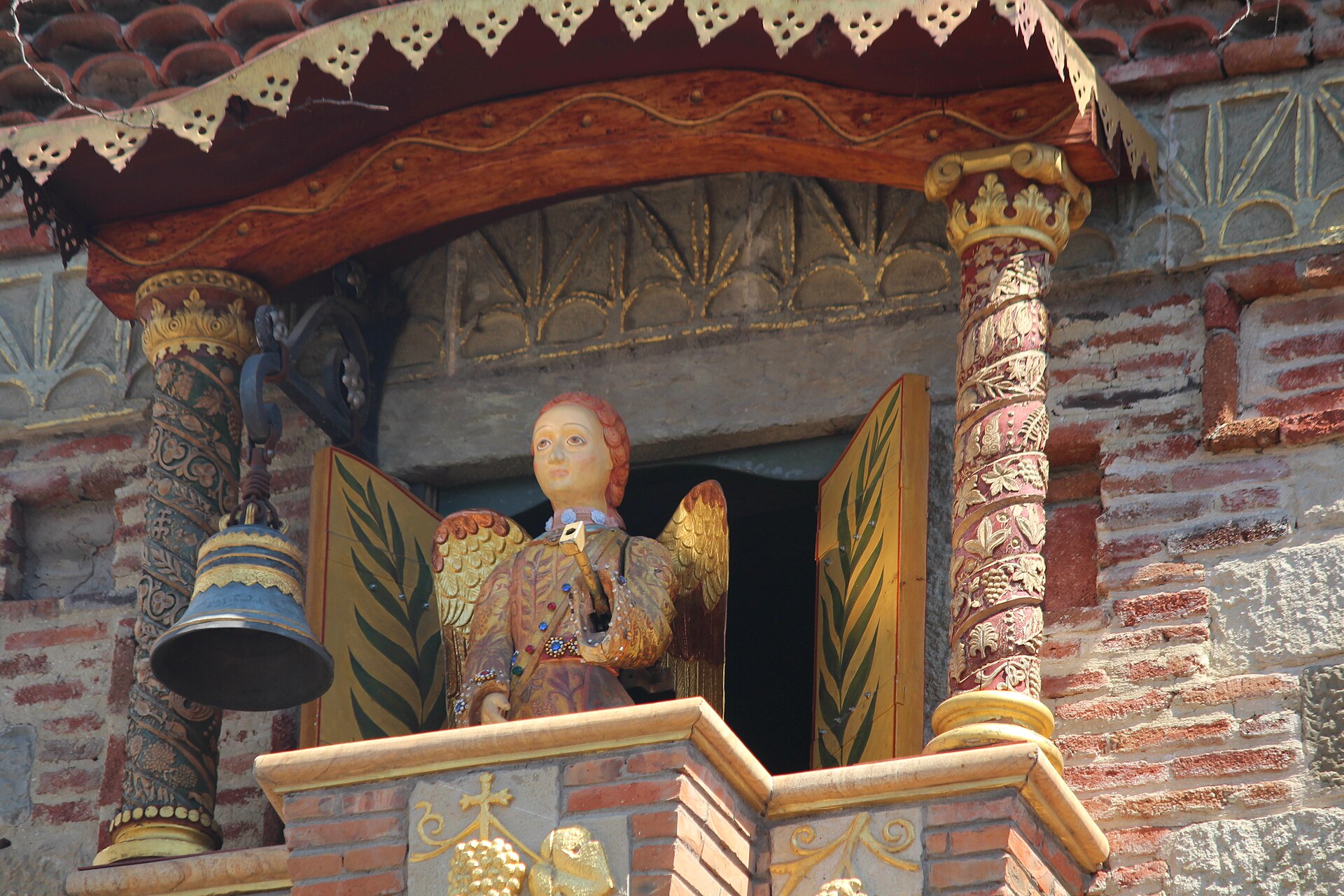
Then look for the clock tower of the Rezo Gabriadze Marionette Theatre on Shavteli Street. Gabriadze, a writer, artist and puppet master, founded the theatre in 1981 and built the tower in 2010 to look like a deliberately crooked fairy-tale ruin of brick, tiles and painted panels. Every hour an angel steps out to strike the bell, and twice a day, at noon and 7 pm, a short free puppet show called The Circle of Life plays in the little stage below the clock. Arrive a few minutes early and stand back across the street.
From there, cross the river on the Bridge of Peace, the curving steel and glass pedestrian bridge designed by the Italian architect Michele De Lucchi and opened in 2010. It looks best at night, when its LED canopy lights up. On the left bank, Metekhi Church of the Assumption, built around 1278 to 1284 under King Demetre II, stands on its cliff beside the equestrian statue of Vakhtang Gorgasali, gazing back over the city he is said to have founded.
Sololaki: The Old Town’s Art Nouveau Back Rooms
Most visitors never climb the few streets west of Freedom Square into Sololaki, and they miss the most rewarding architecture in the city. Sololaki grew in the nineteenth century on land that had been gardens of Georgian noble families, and by the early twentieth century it was where merchants and industrialists built mansions in the eclectic and art nouveau styles. Walk slowly along streets such as Ivane Machabeli, Galaktion Tabidze and Asatiani, and do what locals do: look through open doors. Many apartment entrances, the sadarbazo, still have painted ceilings, carved wooden stairs and tiled floors, often faded and unrestored. Be discreet; these are homes, not museums.
The Writers’ House of Georgia at Ivane Machabeli Street 13 is the best place to start. Built between 1903 and 1905 for the brandy maker David Sarajishvili, it mixes art nouveau with neo-baroque details, and its terrace is laid with Villeroy and Boch tiles. In the 1920s it was a meeting place for the Blue Horns poets; today it hosts literary events and a small museum dedicated to writers repressed under Soviet rule. It is one of the few places where you can step inside a Sololaki mansion without knocking.
Dry Bridge, Wine and the Supra: The Old Town After Sightseeing
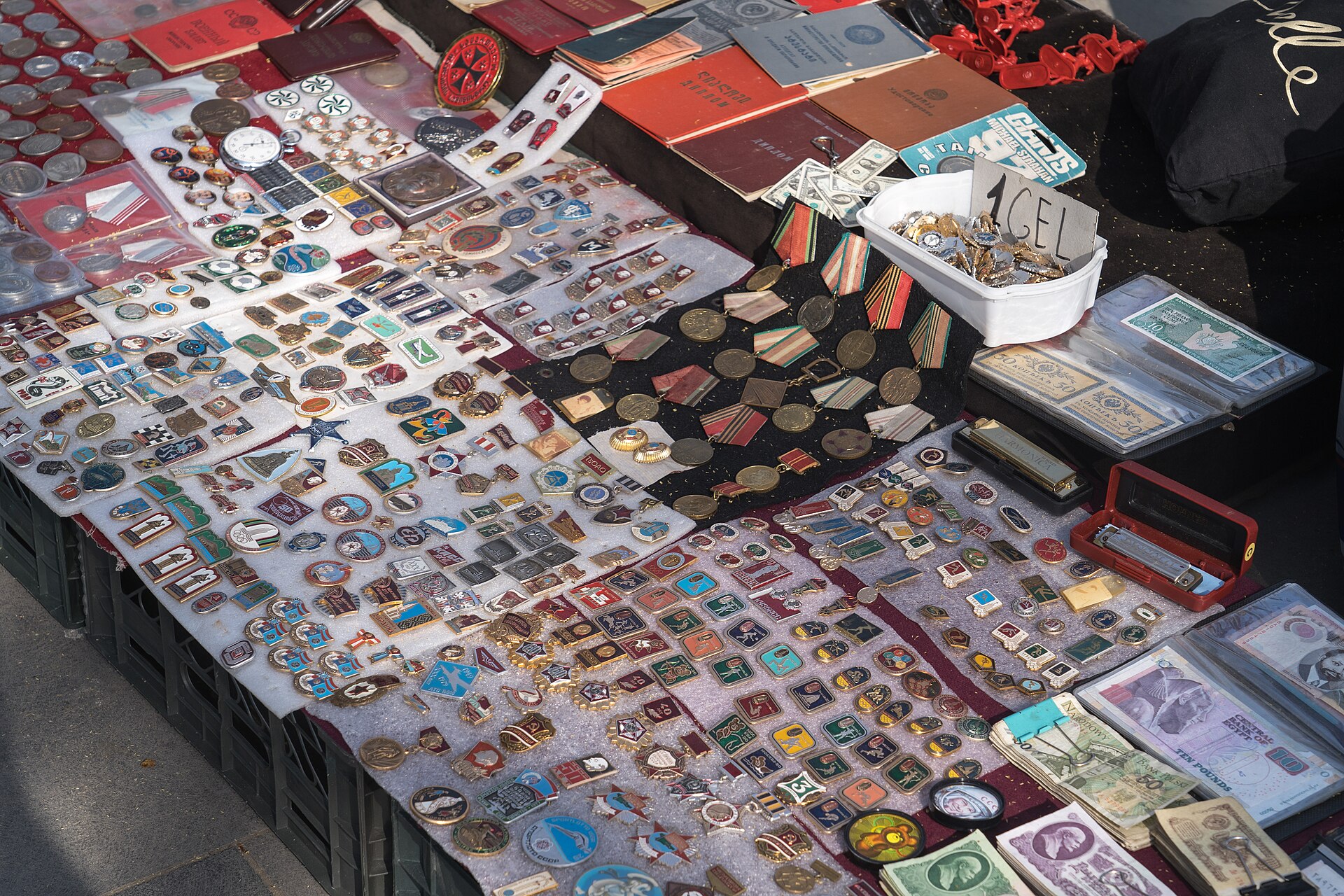
At the northern edge of the old town, around the Dry Bridge, a flea market spreads along the embankment and into the adjoining park. Painters sell canvases, and tables are crowded with Soviet badges, medals, cameras, old banknotes, vinyl, enamel signs and Georgian silver. Go in the morning, bargain politely, and remember that exporting genuine antiques or historic items can require paperwork, so check before buying anything that looks valuable.
Evenings belong to food and wine. Georgia has one of the oldest winemaking traditions in the world: archaeologists have found evidence of grapes and clay vessels in the south of the country dating back to the sixth millennium BC. The traditional method ferments wine in the qvevri, a large egg-shaped clay jar buried in the ground, and amber wines made this way, fermented with their skins, are the best introduction. Order them by the glass in a wine bar before committing to a bottle. Pair them with khinkali dumplings, cheese-filled khachapuri, aubergine rolls with walnut paste and churchkhela, the nut sweets threaded on strings.
If you are invited to a supra, the Georgian feast, accept. The table is run by a tamada, the toastmaster, who proposes a sequence of toasts to peace, to the dead, to parents, to friends and to the guests. You drink when the toast is made, not whenever you like, and a long supra is a marathon, not a sprint.
Practical Notes: Seasons, Getting Around and Pace
The best months are May and June, and September to October, when the days are warm and evenings are long. July and August can be very hot in the stone lanes, while winter is cool but quiet, a fine time for the baths. In autumn the grape harvest, rtveli, draws people to the wine region of Kakheti, a natural day trip once the city has had its due.
The Tbilisi Metro, opened in 1966, has two lines; Liberty Square (Tavisuplebis Moedani) is the most useful station for the old town and Sololaki, and Avlabari serves the left bank near Metekhi and Rike Park. Buy a Metromoney card at any station: it covers the metro, city buses and the Narikala cable car. Ride-hailing apps are widely used, and they spare you the negotiations of street taxis. Inside the old town, though, the best transport is your own feet and sturdy shoes, because the lanes are steep and the cobbles slippery after rain.
Plan two full days for the old town alone: one for Narikala, the baths and Kala, another for Sololaki, the Dry Bridge and a long dinner. Tbilisi rewards those who look past the obvious frames. The balconies and the domes will find you anyway; the city only reveals itself when you start reading what holds them together.
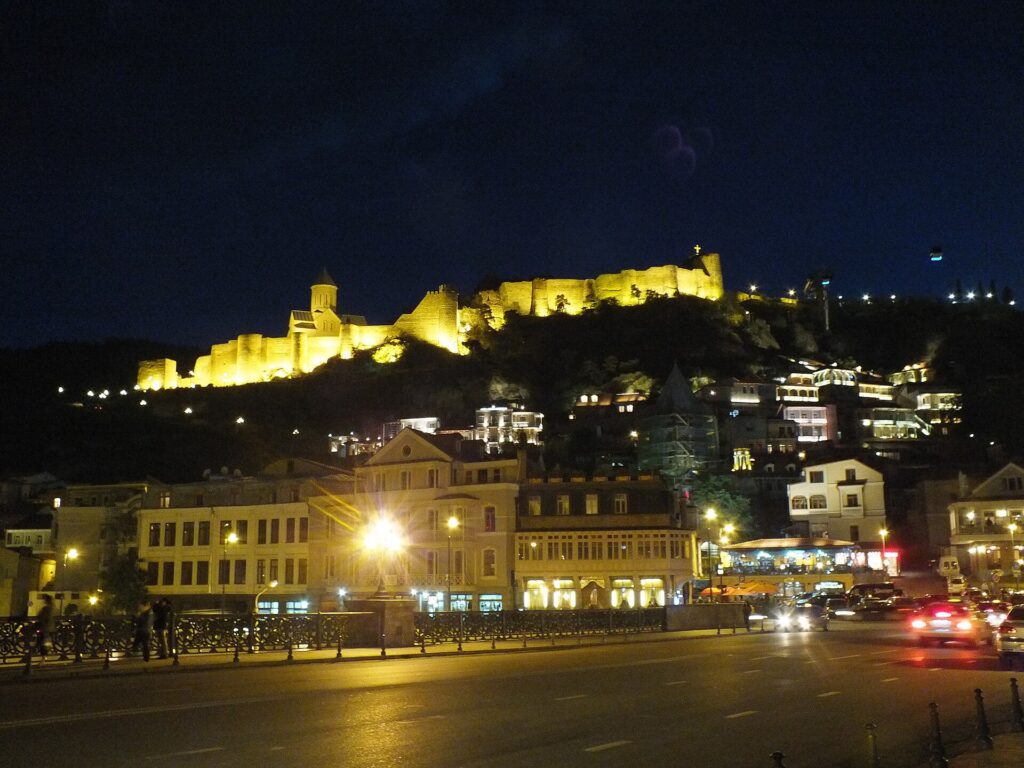
Featured image: Narikala fortress lit up above the old town of Tbilisi after dark. Photo: Saskia Heijltjes / Wikimedia Commons, CC BY-SA 2.0