
The way we listen and understand language is surprisingly contagious. In human communication, consonants often convey more information than vowels. This phenomenon is consistent across many languages; stripping sentences down to their essentials makes them more recognizable when consonants dominate. For instance, Spanish features 23 consonants and five vowels, a ratio prevalent in nearly all languages. This is also why people tend to drop vowels in short messages—our brains are adept at filling in the gaps.
Table of Contents
ToggleDogs Share Consonant Preference
Traditionally, this consonant bias was considered a unique human trait. However, a recent study published in the journal Science reveals that dogs exhibit a similar consonant preference. According to Attila Andics, lead author and neuroethologist at Loránd Eötvös University in Hungary, “They make a very useful model for investigating these questions because, unlike laboratory animals, they hear human speech daily.”
Research Methodology
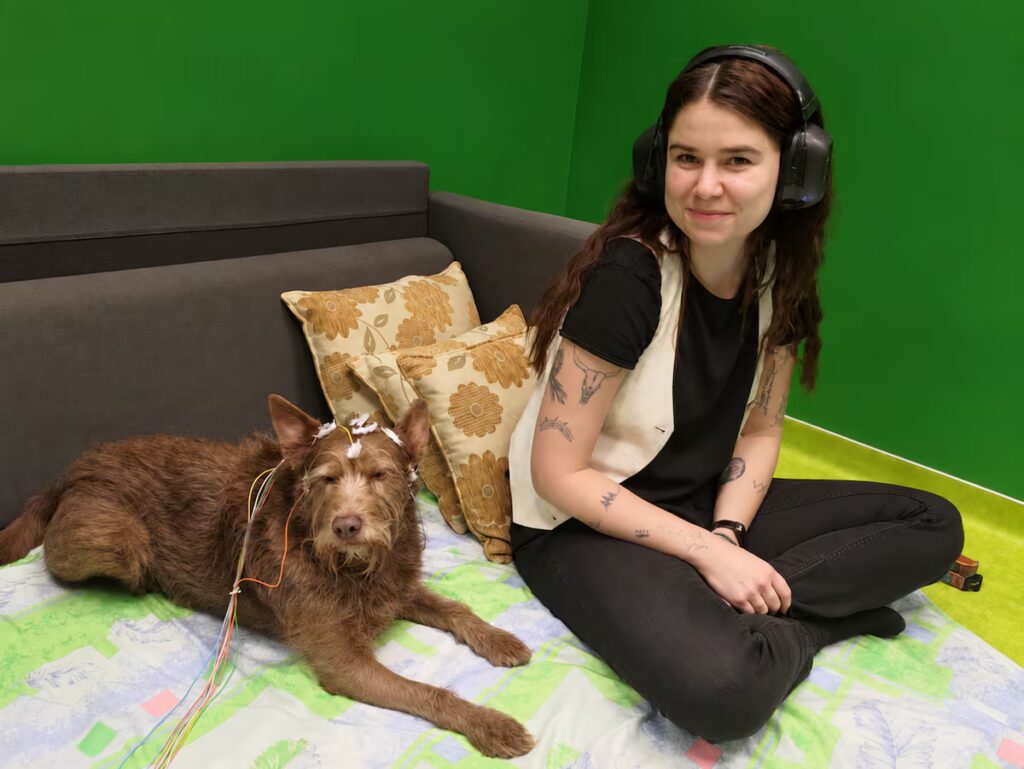
The study compared the electroencephalographic responses of 20 human adults and 20 pet dogs as they listened to streams of nonsensical three-syllable words. These words were organized based on either consonants or vowels, with a third set lacking any consistent pattern. Research co-author Dorottya Rácz stated, “We found striking similarities in how both species processed these speech sequences.” Both humans and dogs effectively segmented continuous speech into recognizable words when the recurring patterns were predominantly consonants.
Implications on Language Processing
This discovery suggests that regular exposure to speech can alter brain function and allow language-processing biases, once thought exclusive to humans, to develop even without advanced linguistic abilities. Juan Manuel Toro, a professor at the Center for Brain and Cognition at Pompeu Fabra University, emphasized that domestic dogs, being exposed to human language from birth, can similarly focus on consonants to identify words.
Further Insights into Language Models
Interestingly, Toro previously presented a study demonstrating that ChatGPT also developed a consonant-preference bias, a research reference in Andics’s study. Toro explained, “These models are trained on enormous amounts of text and learn to detect regularities,” leading them to conclude that consonants provide more useful information for word identification than vowels.
Evolution of Consonant Preference
The investigation of consonant preference dates back 20 years, initially focusing on infants using this strategy to recognize words, a skill that persists into adulthood. Additional studies have identified prosody, or the rhythm of speech, as a vital tool for children learning to understand adult language. Toro has also examined this phenomenon in rats, which demonstrated similar response patterns, suggesting that the mechanisms underlying language processing in infants may be shared with other animals.
The Complexity of Human Language
Human language serves as an intricate communication system filled with complexities. Infants begin to form a system to express limitless ideas using a limited number of sounds, akin to piecing together a puzzle with infinite combinations. This ability allows for the expression of intricate thoughts and emotions. One of the primary challenges in language study is unraveling its biological foundations—whether it’s a uniquely human capability, an innate characteristic, or a learned cultural skill. Current animal studies are offering insights into how humans acquire and process language.